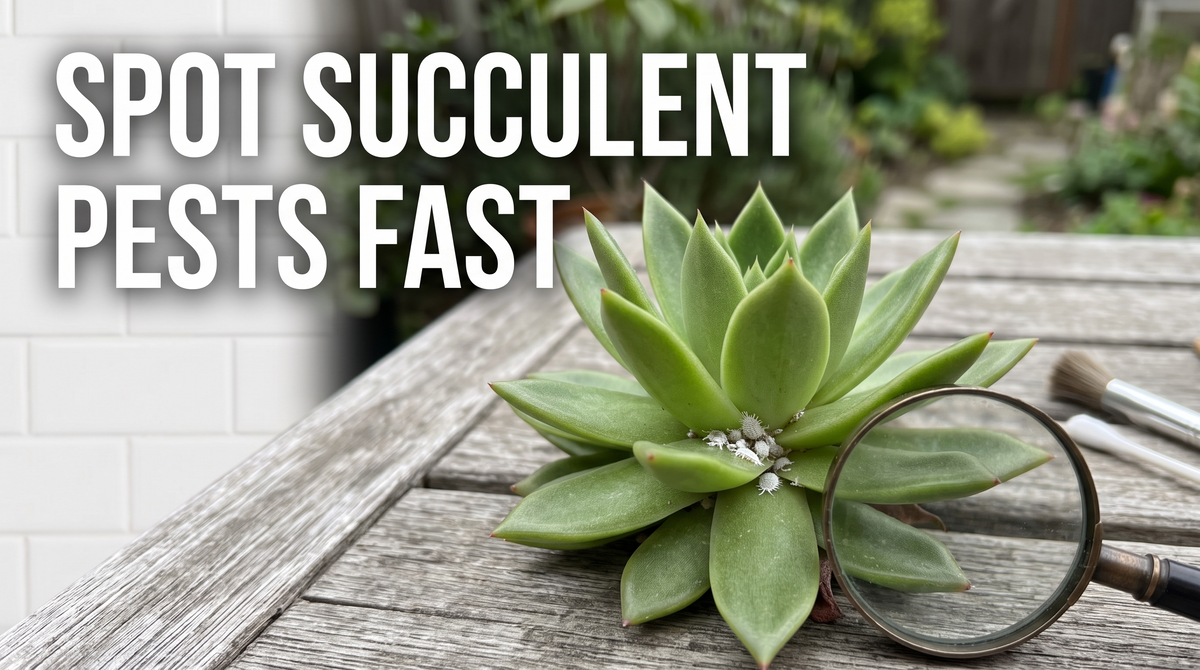
How to Identify and Treat Common Succulent Pests
Succulents are often considered easy-care plants, but even healthy-looking plants can occasionally attract pests.
Small insects may hide between leaves, along stems, around the base of the plant, or underneath leaves where they are difficult to notice. By the time visible damage appears, a pest population may already be established.
The good news is that many common succulent pest problems can be managed when they are discovered early.
The key is knowing what to look for.
White cotton-like patches may indicate mealybugs. Small bumps attached to stems or leaves may be scale insects. Fine webbing and pale speckling can point toward spider mites. Tiny flying insects around the soil may be fungus gnats.
This guide explains how to identify common succulent pests, recognize their damage, and choose practical treatment methods that are appropriate for beginner succulent growers.
Why Do Succulents Get Pests?
Succulents are not immune to insect problems.
Pests can arrive with a newly purchased plant, spread from another houseplant, or become established when plants are stressed or growing in unfavorable conditions.
Some common succulent pests feed directly on plant sap. Others are associated with moist growing media or damaged plant tissue.
RHS identifies several sap-feeding pests that can affect indoor plants, including succulents, with mealybugs, scale insects, aphids, thrips, and spider mites among the common problems.
A pest infestation does not automatically mean that you have been caring for your succulent incorrectly.
However, good growing conditions can help plants remain stronger and easier to manage.
Bright enough light, appropriate watering, good drainage, and regular inspection are all important parts of prevention.
The Most Common Succulent Pests
The pests you are most likely to encounter include:
Mealybugs
Scale insects
Spider mites
Aphids
Fungus gnats
Thrips
Not every succulent will experience all of these pests.
Some problems are also easier to identify than others.
The important thing is to inspect the plant carefully before choosing a treatment.

-
Mealybugs
Mealybugs are among the most recognizable succulent pests.
They are small, soft-bodied insects covered in a white, waxy material that can make them look like tiny pieces of cotton.
They often hide where succulent leaves meet the stem.
They may also gather around growing points, underneath leaves, or in difficult-to-see crevices.
Some mealybugs can even be found around the lower portion of a plant or below the soil surface.
Signs of Mealybugs
Look for:
White cotton-like clusters
Small insects around leaf joints
Sticky residue on leaves
Yellowing leaves
Weak or slow growth
Wilting despite apparently adequate watering
Mealybugs feed on plant sap, and heavier infestations can weaken the plant.
The sticky substance known as honeydew can also appear on plant surfaces.
How to Treat Mealybugs
For a small infestation, physical removal is often a practical first step.
Use a cotton swab or tweezers to remove visible insects.
University of Minnesota Extension specifically recommends removing mealybugs with tweezers or a cotton swab dipped in alcohol.
After removing the visible pests, inspect the plant again several days later.
Do not assume that removing one visible cluster means the entire infestation has disappeared.
Repeat inspections are important because small pests can remain hidden.
-
Scale Insects
Scale insects can be particularly difficult to notice because they may look like small bumps attached to the plant.
They can appear brown, gray, white, or other colors depending on the type.
They are often found along stems or on the underside of leaves.
Some scale insects produce honeydew, which can make leaves and nearby surfaces feel sticky.
Signs of Scale
Look for:
Small raised bumps
Brown, gray, or white spots attached to stems
Sticky leaves
Yellowing foliage
Slow growth
Weak-looking new growth
Scale insects can be difficult to remove once established because mature insects may have protective coverings.
How to Treat Scale
For a small infestation, physically removing the insects can be effective.
Carefully wipe or scrape visible scale from the plant without damaging the succulent's tissue.
Pruning badly affected sections can also help reduce the pest population.
For larger infestations, products such as insecticidal soaps or horticultural oils may be used when labeled for the plant and pest involved.
Treatment may need to be repeated because different life stages can respond differently to control methods.
-
Spider Mites
Spider mites are extremely small and can be difficult to see without magnification.
They tend to become more noticeable through the damage they cause.
The leaves may develop tiny pale dots or a stippled appearance.
In heavier infestations, fine webbing may appear.
Spider mites can thrive in warm, dry conditions, and severe infestations can weaken plants considerably.
Signs of Spider Mites
Look for:
Tiny pale speckles on leaves
Yellowing or bronzing
Fine webbing
Weak or declining growth
Leaves that look dusty or faded
Tiny moving dots underneath leaves
If you suspect spider mites, place a white sheet of paper underneath a leaf and gently tap the leaf.
Very small moving creatures may become easier to see against the white background.
How to Treat Spider Mites
Start by physically removing as many pests as possible.
A careful rinse can help dislodge mites and their webbing.
For more persistent infestations, an insecticidal soap or horticultural oil labeled for the plant can be considered.
These products generally need direct contact with the pests and may require repeat applications.
Avoid applying treatments to a severely stressed or sun-exposed plant without checking the product directions.
Some products can damage succulent foliage under unfavorable conditions.
-
Aphids
Aphids are more commonly noticed on soft new growth, flower stalks, and developing leaves.
They can be green, black, yellow, brown, or other colors depending on the species.
They feed by sucking plant sap.
Signs of Aphids
Look for:
Clusters of tiny insects
Distorted new growth
Curling leaves
Sticky honeydew
Weak flower growth
Small insects around flower buds
Aphids may be easier to spot than spider mites because they are larger and often gather in groups.
How to Treat Aphids
For small infestations, physically remove the insects or rinse the plant gently.
Pruning heavily affected sections can also help.
If a larger infestation persists, use a product labeled for aphids and the particular succulent you are treating.
Always follow the product label carefully.
-
Fungus Gnats
Fungus gnats are different from many of the pests discussed above because their larvae are associated with moist growing media.
Adult fungus gnats look like tiny flying insects.
You may notice them flying around the pot whenever you water or disturb the soil.
The presence of fungus gnats can be a sign that the growing medium is staying too wet.
University of Minnesota Extension notes that fungus gnats prefer wet or moist soil and recommends allowing soil to dry between watering while using appropriate controls when needed.
Signs of Fungus Gnats
Look for:
Tiny flying insects around pots
Gnats appearing after watering
Small larvae in moist growing media
Soil that remains wet for long periods
How to Reduce Fungus Gnats
Review your watering routine first.
Succulents generally prefer well-drained growing media and should not remain constantly wet.
Allow the appropriate portion of the growing medium to dry between waterings according to the needs of the particular succulent.
Yellow sticky traps can help monitor adult fungus gnats.
If the problem continues, consider changing the growing conditions and using a treatment specifically labeled for fungus gnat larvae when appropriate.
-
Thrips
Thrips are tiny insects that can cause significant cosmetic damage.
They feed on plant tissue and can leave leaves looking dull, silvery, or scarred.
They may be particularly difficult to spot because of their small size.
Signs can include:
Silvery patches
Scarring
Distorted new growth
Discolored leaves
Damage around young leaves or flowers
RHS notes that thrips feeding can cause leaves to become increasingly dull or silvery.
How to Treat Thrips
Begin by isolating the affected plant.
Remove badly damaged plant material when appropriate.
Wash or rinse the plant carefully.
For persistent infestations, use a suitable product labeled for thrips and the plant being treated.
Repeat monitoring is essential because a single treatment may not eliminate every life stage.
How to Tell Pest Damage From Normal Succulent Problems
Not every yellow, brown, soft, or damaged leaf means that your succulent has pests.
This is important.
Succulents can develop similar symptoms because of:
Overwatering
Underwatering
Sunburn
Insufficient light
Root problems
Cold damage
Physical damage
Natural aging
For example, spider mite feeding can create pale speckling that may initially look like environmental stress.
Mealybugs can produce yellowing and weak growth that might otherwise be blamed on watering problems.
The best approach is to inspect the plant closely before deciding what is wrong.
Check the underside of leaves.
Look between leaves and stems.
Inspect new growth.
Examine the pot rim and surrounding surface.
Use a magnifying glass if necessary.
University of Minnesota Extension recommends checking both the upper and lower leaf surfaces, containers, and other areas around the plant because small pests can be difficult to detect.
Should You Isolate an Infested Succulent?
Yes.
If you suspect a succulent has pests, move it away from your other plants.
This is one of the simplest ways to reduce the chance of spreading an infestation.
Place the affected plant in a separate location while you inspect and treat it.
Also check nearby plants.
A pest problem rarely respects the boundaries of a single pot.
Look carefully at neighboring succulents, especially plants that touch the affected plant.
How Long Should You Isolate a Succulent?
There is no universal number of days that guarantees a plant is pest-free.
Instead, inspect the plant repeatedly.
Watch for:
New pests
Fresh damage
Sticky residue
New webbing
Returning white clusters
Scale returning on stems
New flying insects
Continue monitoring until you are confident that the problem has been controlled.
For newly purchased plants, quarantine is also a useful preventative practice. University of Minnesota Extension recommends isolating new plants for one to two weeks so potential pest problems have time to become visible.
How to Prevent Succulent Pest Problems
Prevention starts with inspection.
When buying a new succulent, check:
The underside of leaves
Leaf joints
Stems
Growing points
The soil surface
The pot rim
The bottom of the container
Look for insects, webbing, sticky residue, discoloration, or unusual bumps.
Do not immediately place a new plant next to your established collection.
Quarantine gives you time to observe the plant before introducing it to the rest of your collection.
Keep Succulents Healthy
Good basic care does not make a succulent completely pest-proof, but it can help reduce stress.
Provide appropriate light.
Use a well-draining growing medium.
Use containers with drainage holes.
Avoid keeping the soil constantly wet.
Water according to the plant's needs rather than following a rigid calendar.
University of Minnesota Extension recommends bright light and well-drained growing conditions for cacti and succulents and notes that excessive moisture can contribute to rot.
Do Not Overcrowd Your Plants
Succulents look beautiful when grouped together, but very tight arrangements can make inspection more difficult.
Give plants enough space that you can see the stems and leaf surfaces.
Good spacing also makes it easier to isolate one plant if a pest appears.
Clean Your Tools
If you prune an infested plant, clean your tools before using them on another plant.
Wash your hands after handling affected plants.
This simple habit can help reduce accidental spread.
Inspect Plants Regularly
You do not need to perform a detailed inspection every day.
Instead, make inspection part of your normal care routine.
When watering or rotating your succulents, take a few seconds to look underneath the leaves and around the stems.

Early detection can make pest management much easier.
A Simple Succulent Pest Treatment Routine
If you discover pests, follow a simple process.
Step 1: Isolate the plant.
Step 2: Identify the pest.
Step 3: Inspect the entire plant.
Step 4: Check nearby plants.
Step 5: Remove visible pests when practical.
Step 6: Clean or rinse the plant if appropriate.
Step 7: Apply a suitable labeled treatment if necessary.
Step 8: Monitor the plant repeatedly.
Step 9: Repeat treatment according to the product label when required.
Step 10: Return the plant to the collection only after the infestation appears controlled.
This approach is usually more effective than immediately applying several different products at once.
Should You Use Rubbing Alcohol on Succulents?
Alcohol is sometimes used to remove individual mealybugs or scale insects.
For a small, localized infestation, a cotton swab lightly moistened with alcohol can be used to target visible pests.
University of Minnesota Extension specifically lists alcohol-dipped cotton swabs as an option for physically removing mealybugs.
However, do not assume that more alcohol is better.
Test a small area first, avoid soaking the entire plant, and keep treated tissue away from strong direct sunlight until you know how the plant reacts.
For larger infestations, a product specifically labeled for succulent pest control may be more practical.
What About Insecticidal Soap and Horticultural Oil?
Insecticidal soaps and horticultural oils are commonly used for several soft-bodied pests and mites.
They generally work through direct contact rather than providing long-lasting protection.
This means thorough coverage and repeat applications may be necessary.
University of Minnesota Extension notes that insecticidal soaps and horticultural oils can be effective against several common indoor plant pests, including scale, aphids, thrips, and spider mites.
Always read the product label before applying any pesticide.
The label should specify the plants, pests, application rate, and safety precautions.
Do not use homemade soap mixtures simply because they seem similar to commercial insecticidal soap. Some homemade mixtures can damage plant tissue.

When Should You Remove an Infested Succulent?
Most small infestations do not mean you need to throw away the plant.
However, a severely infested or badly damaged succulent may be difficult to save.
If a plant is heavily infested, declining rapidly, or repeatedly reinfests nearby plants, removing it may sometimes be the most practical option.
University of Minnesota Extension notes that disposing of a heavily infested and badly damaged plant can prevent exposure of other plants.
Before making that decision, consider whether the plant has healthy growth that can be preserved through pruning or propagation.
Common Succulent Pest Control Mistakes
One of the biggest mistakes is treating the wrong problem.
If yellow leaves are caused by overwatering, insecticide will not fix the root problem.
Another common mistake is treating only the visible insects.
Pests can hide under leaves, around leaf joints, or in the soil.
Other mistakes include:
Ignoring nearby plants
Failing to isolate an infested plant
Using too much pesticide
Using homemade soap solutions
Skipping repeat inspections
Applying treatments to severely stressed plants
Returning a treated plant to the collection too quickly
Ignoring the growing conditions that may be stressing the plant
A careful inspection and targeted approach are usually better than using multiple treatments without identifying the pest.
Final Thoughts
Common succulent pests can be frustrating, but they do not have to become a disaster for your plant collection.
The most important skill is learning to recognize the early signs.
White cotton-like material often points toward mealybugs.
Small bumps on stems or leaves may indicate scale.
Fine webbing and pale speckling can suggest spider mites.
Sticky leaves may indicate sap-feeding pests such as aphids, mealybugs, or scale.
Tiny flying insects around consistently moist soil may indicate fungus gnats.
Once you identify the problem, isolate the affected succulent, remove pests when practical, choose an appropriate treatment, and continue monitoring the plant.
Prevention is equally important.
Inspect new plants before adding them to your collection, give succulents suitable growing conditions, and make regular inspection part of your normal care routine.
If you are growing succulents indoors, choosing the right plants for your available light can also make your collection easier to manage. For more ideas, see our guide to Best Succulents for Low-Light Indoor Spaces.
Healthy plants, regular inspection, and early intervention can go a long way toward keeping a succulent collection beautiful and pest-free.