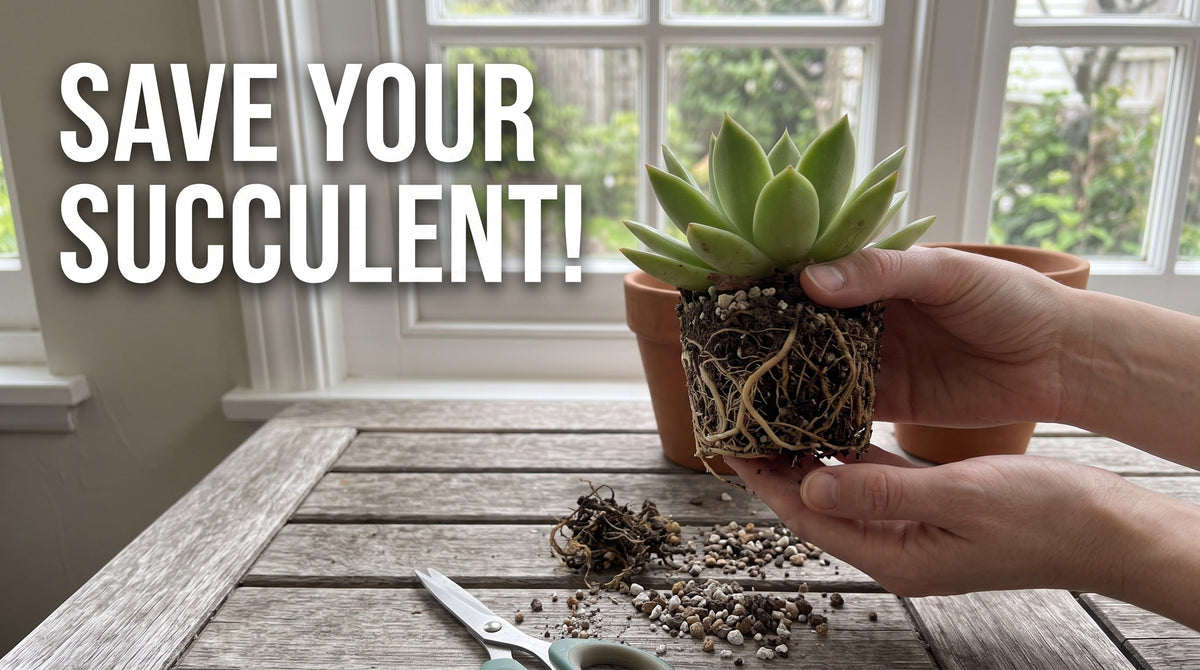
Succulent Root Rot: Causes, Signs, and How to Save Your Plant
Succulents are often considered easy-care plants, but they have one common problem that can become serious very quickly: root rot.
Root rot usually develops when succulent roots remain wet for too long. Poor drainage, overly frequent watering, compact soil, a pot without adequate drainage, low light, and cool or humid conditions can all contribute to problems with excess moisture.
The difficult part is that root rot can begin underneath the soil before the plant looks obviously unhealthy.
By the time the leaves become yellow, soft, or the stem begins to collapse, the roots may already be badly damaged.
The good news is that early detection can give a succulent a chance to recover.
This guide explains what succulent root rot looks like, what causes it, how to check the roots, and what you can do to save a plant before the damage spreads.
What Is Succulent Root Rot?
Succulent root rot is the deterioration and death of roots caused by prolonged unfavorable conditions, especially excessive moisture and poor drainage.
Succulents are adapted to storing water in their leaves and stems. They generally need less frequent watering than many tropical houseplants. University of Minnesota Extension recommends well-drained growing media and allowing succulent soil to dry completely between waterings.
When the soil remains wet for too long, the roots can become damaged.
Damaged roots can no longer function normally.
The plant may then begin to show symptoms above the soil even though the original problem is below the surface.
In severe cases, rot can move from the roots into the stem and eventually cause the entire plant to collapse.
What Causes Root Rot in Succulents?
Root rot usually has more than one contributing factor.
The most common causes include:
Overwatering
Poor drainage
Water-retaining soil
A pot without drainage holes
A pot that is too large for the plant
Low light
Cool temperatures combined with wet soil
Poor airflow
Repeated watering before the soil has dried
Understanding these causes is important because simply removing damaged roots may not solve the problem if the plant is returned to the same wet conditions.
-
Overwatering
Overwatering is one of the most common causes of succulent root problems.
This does not necessarily mean giving a plant a huge amount of water at one time.
Watering too frequently can be enough.
If the soil is still damp when you water again, the roots may remain wet for an extended period.
Succulents generally do better when they receive a thorough watering followed by a period in which the growing medium dries out. University of Minnesota Extension specifically advises allowing succulent soil to dry completely between waterings.
-
Poor Drainage
Even if you have a good watering routine, poor drainage can create problems.
A container should have an appropriate drainage hole so excess water can escape.
A pot with no drainage hole can trap water around the roots.
RHS also recommends using well-drained growing media for cacti and succulents because excessive moisture can lead to rot.
-
Heavy or Water-Retaining Soil
Succulents generally prefer porous, well-drained growing media.
Dense soil can remain wet for too long.
University of Minnesota Extension notes that most cacti and succulents grow naturally in well-drained sandy conditions and recommends a porous growing mix.
A commercial cactus and succulent mix can be a convenient starting point.
Depending on the plant and growing environment, growers may also amend the mix with materials that improve drainage and aeration.
-
A Pot That Is Too Large
A larger pot is not always better.
When a small succulent is placed into a much larger container, there may be a large amount of unused soil around the root system.
That extra soil can stay wet for longer.
RHS notes that overpotting can create soggy conditions around roots because the excess compost takes longer to dry.
Choose a container that is appropriately sized for the plant rather than automatically moving it into the largest available pot.
-
Insufficient Light
Light affects how actively a succulent grows and uses water.
Succulents generally need plenty of light, and University of Minnesota Extension recommends bright light for cacti and succulents.
If a plant receives little light while also being watered frequently, the growing medium may stay wet longer.
This combination can increase the risk of root problems.
-
Cool, Wet Conditions
Temperature can also influence how quickly soil dries and how well a plant grows.
RHS notes that excessive moisture and cold temperatures can contribute to rot problems in succulents.
This is particularly important during winter.
A plant that needed regular watering during a bright growing period may need considerably less water when growth slows and conditions become cooler.
Signs of Root Rot in Succulents
Root rot can be difficult to identify because some symptoms look similar to underwatering.
Look for several symptoms together rather than relying on one sign.
Common warning signs include:
Yellowing leaves
Soft or mushy leaves
Leaves dropping unexpectedly
Wilting despite wet soil
Slow or stunted growth
A soft stem
Dark or discolored roots
Mushy roots
A darkening stem near the soil line
A foul or unpleasant smell from wet soil
Sudden plant collapse
RHS identifies yellowing leaves, wilting, browning, mouldy patches, stem rot, and dark, mushy roots among signs associated with overwatering and root or stem problems.

The most important clue is often this:
The plant looks thirsty, but the soil is still wet.
That situation deserves closer inspection.
How to Tell Root Rot From Underwatering
This is one of the most important distinctions for succulent owners.
Both overwatering and underwatering can cause a succulent to look wilted.
An underwatered succulent may have:
Shrivelled leaves
Dry soil
Crispy or wrinkled foliage
A lightweight pot
An overwatered succulent with root rot may have:
Wet soil
Soft or translucent leaves
Yellowing leaves
A weak or soft stem
Dark, mushy roots
Wilting despite moist soil
The key is to check the soil and, when necessary, inspect the roots.
RHS notes that symptoms of water stress can overlap, making it important to check the condition of the roots when diagnosing the problem.
How to Check a Succulent for Root Rot
If you strongly suspect root rot, carefully remove the plant from its container.
Do not pull aggressively on the stem.
Instead, loosen the soil around the pot and gently slide the root ball out.
Inspect the roots.
Healthy roots are generally firm and structurally intact.
Rotten roots may appear:
Dark brown or black
Soft
Mushy
Weak
Shrivelled
Easily broken apart
University of Minnesota Extension's descriptions of root rot in plants include darkened or discolored roots, loss of root hairs, and deterioration of outer root tissue.
Also inspect the base of the stem.
If the stem is soft, dark, or collapsing near the soil line, the problem may have progressed beyond the roots.

How to Save a Succulent With Root Rot
If the plant still has healthy tissue, you may be able to save it.
The exact approach depends on how much of the plant remains healthy.
Step 1: Remove the Plant From the Soil
Gently remove the succulent from its pot.
Shake or brush away the wet soil around the roots.
You need to see what is happening below the surface.
Do not immediately place the plant into another pot with fresh wet soil.
The damaged roots need to be assessed first.
Step 2: Inspect the Roots
Separate healthy roots from visibly rotten tissue.
Look for firm roots that remain intact.
Remove roots that are clearly dark, soft, slimy, or decomposing.
Use a clean, sharp tool to make clean cuts.
Avoid repeatedly crushing or tearing the roots.
Step 3: Remove Rotten Tissue
Cut away the damaged root sections.
If rot has reached the lower stem, continue inspecting the plant carefully.
The goal is to remove visibly rotten tissue while preserving as much healthy plant tissue as possible.
If the entire root system and lower stem are severely rotten, the original root system may not be recoverable.
In that situation, healthy upper growth may sometimes be used for propagation, depending on the succulent species.
Step 4: Allow Damaged Areas to Dry
After removing rotten tissue, give the plant time to dry before placing it into fresh growing media.
The exact drying time varies according to the plant, size of the cuts, temperature, humidity, and environment.
The important principle is to avoid immediately placing freshly cut, damaged tissue into persistently wet soil.
Succulent propagation guidance from University of Minnesota Extension similarly recommends allowing cutting wounds to air dry before planting.
Step 5: Use Fresh, Well-Drained Soil
Do not automatically reuse the old wet soil around a plant that has suffered serious root rot.
Use fresh growing media appropriate for succulents.
Choose a pot with drainage.
The new container does not need to be dramatically larger than the remaining root system.
A properly sized pot can help the soil dry at an appropriate rate.
Step 6: Replant Carefully
Place the healthy roots into the fresh growing medium.
Do not bury the stem deeper than necessary.
Make sure the plant is stable.
Avoid compacting the soil excessively around the roots.
Good aeration and drainage are important after recovery.

Step 7: Be Careful With the First Watering
Do not return immediately to the same watering routine that caused the problem.
Give the plant time to recover and follow a watering schedule based on the plant's species, growing conditions, light, temperature, and soil dryness.
Once established, water thoroughly when appropriate and allow excess water to drain away.
Avoid leaving the pot sitting in a saucer of standing water.
What If the Roots Are Completely Rotten?
Sometimes there are almost no healthy roots left.
This does not always mean the entire succulent must be discarded.
If the upper stem or leaves are still healthy, propagation may be possible depending on the species.
For stem-forming succulents, you may be able to cut above the damaged section and allow the healthy cutting to callus before re-rooting it.
For leaf-propagating species, healthy leaves may sometimes produce new plants.
However, not every succulent propagates successfully from leaves.
Do not assume the same method works for every species.
University of Minnesota Extension notes that many succulents can be propagated from stem cuttings and that some can also produce new plants from leaves.
How to Prevent Succulent Root Rot
Saving a damaged succulent is useful, but prevention is even better.
-
Use a Pot With Drainage
Always choose an appropriate container with drainage.
Excess water needs a way to leave the root zone.
-
Use a Fast-Draining Growing Mix
Choose a growing medium designed for cacti and succulents or create an appropriate porous mix for your conditions.
The goal is to prevent the root zone from remaining saturated.
-
Check the Soil Before Watering
Do not water simply because it is a particular day of the week.
Check whether the soil has dried sufficiently.
RHS recommends checking growing-medium moisture rather than relying solely on a fixed watering schedule.
-
Give Your Succulent Enough Light
Bright light helps succulents maintain healthy growth.
However, introduce plants to stronger sunlight gradually if they have been growing in lower light to reduce the risk of stress or sun damage.
-
Reduce Watering During Slow Growth
Many succulents need less water during periods of reduced growth, particularly when light levels are lower.
Do not continue a summer watering routine unchanged throughout the year.
-
Empty Excess Water
After watering, make sure the plant is not left sitting in collected water.
Good drainage should allow excess moisture to leave the container.
-
Avoid Constantly Moist Soil
Succulent roots generally do not benefit from permanently wet conditions.
Allow the growing medium to dry appropriately between waterings.
-
Give Plants Enough Space
Avoid overcrowding plants in containers where airflow is poor.
Good spacing can also make it easier to inspect plants for early signs of trouble.
Root Rot Prevention by Season
Spring
As light increases and plants begin active growth, watering needs may increase.
However, always check the soil rather than following a fixed calendar.
Summer
Succulents may use water more quickly in bright, warm conditions.
Water thoroughly when appropriate and allow excess water to drain.
Fall
As temperatures and light levels change, begin watching the soil more carefully.
Your previous summer watering schedule may become too frequent.
Winter
Winter is an especially important time to avoid overwatering.
Many indoor succulents receive less light and may grow more slowly.
University of Minnesota Extension specifically recommends reducing watering during low-light winter conditions.
Root Rot vs. Other Succulent Problems
Not every yellow leaf means root rot.
Succulents can also experience problems caused by:
Underwatering
Sunburn
Insufficient light
Cold damage
Pests
Nutrient issues
Natural aging
Physical damage
For example, a succulent grown in insufficient light may become weak or misshapen, while excessive cold can cause discoloration or dieback.
This is why it is useful to consider the whole growing environment before deciding that a plant has root rot.
Root Rot and Succulent Pests Are Different Problems
Root rot can sometimes be confused with pest damage because both problems may cause weak growth or leaf loss.
If you notice insects, cottony material, scale-like bumps, or other signs of pests, the diagnosis may be different.
For a separate guide to common insect problems, see our article:
How to Identify and Treat Common Succulent Pests
This internal link is especially useful if your succulent is declining but the roots appear healthy and you suspect insects instead.
Can a Succulent Recover From Root Rot?
Yes, some succulents can recover, particularly when the problem is caught early and healthy tissue remains.
Recovery depends on:
The plant species
How much root damage has occurred
Whether the stem is affected
How much healthy tissue remains
Growing conditions after treatment
The speed at which the problem is addressed
A plant with some healthy roots and a firm stem generally has more options than one with extensive rot throughout the root and stem system.
Do not expect immediate recovery.
Even after the cause is corrected, the plant may need time to rebuild its root system and resume normal growth.
Final Thoughts
Succulent root rot can be frightening, but discovering it does not automatically mean your plant is beyond saving.
The most important step is identifying the problem early.
Watch for yellowing leaves, soft foliage, unexplained wilting, wet soil, and especially dark or mushy roots.
If root rot is suspected, remove the plant from its container, inspect the roots, cut away clearly damaged tissue with a clean tool, allow wounds to dry, and replant the healthy portions in fresh, well-drained growing media.
Then change the conditions that contributed to the problem.
Use a pot with drainage.
Choose an appropriate succulent growing mix.
Provide adequate light.
Check the soil before watering.
And remember that succulents generally need less frequent watering than many other houseplants.
The goal is not to keep your succulent completely dry.
The goal is to create a healthy cycle of thorough watering followed by appropriate drying.
With careful observation and better growing conditions, many succulents can recover from early root problems and continue growing for years.