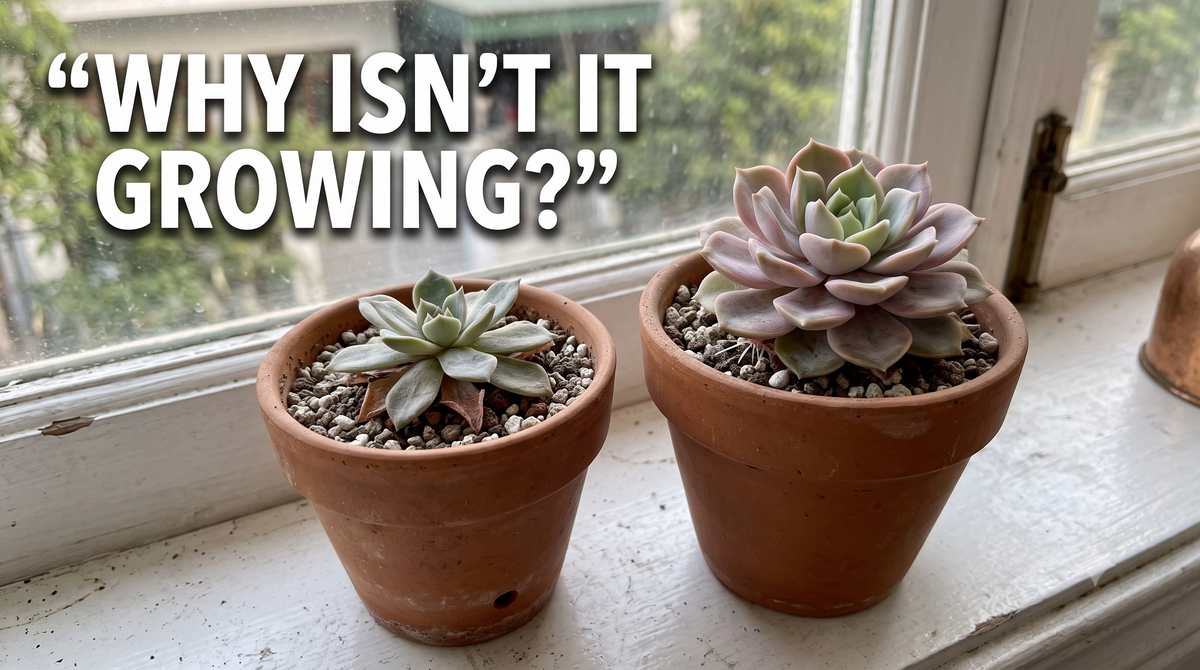
Why Is My Succulent Not Growing? 10 Common Reasons
Succulents are often considered easy-care plants, but “easy” does not mean they grow quickly. If your succulent has looked exactly the same for months, it is natural to wonder what is going wrong.
The good news is that slow or stalled growth does not always mean your plant is unhealthy. Some succulents naturally grow slowly, while others may temporarily pause because of seasonal changes or stressful growing conditions.
However, if your succulent has stopped producing new leaves, looks stretched or pale, stays small for a long time, or seems to be declining, its growing conditions may need attention.
So, why is your succulent not growing?
Here are 10 common reasons to check, along with simple ways to improve its growing conditions.
-
Your Succulent Is Not Getting Enough Light
Light is one of the first things to check when a succulent is not growing.
Succulents generally need abundant light to maintain compact, healthy growth. When indoor plants receive too little light, new growth can become pale, stretched, or unusually thin. Rosette-forming succulents may also open up and flatten their leaves as they try to capture more light.
A plant sitting several feet away from a bright window may look healthy at first but still receive less usable light than it needs.
If your succulent has become tall, stretched, pale, or noticeably tilted toward a window, insufficient light may be part of the problem.
What to do:
Move the plant gradually toward a brighter location rather than suddenly placing a low-light plant in intense direct sun. A bright window can work well indoors, and supplemental grow lights can help when natural light is insufficient.
Remember that different succulent species have different light tolerances. Avoid making a sudden change from low light to strong direct sunlight because this can cause sun damage.

-
You Are Watering Too Often
More water does not necessarily mean faster growth.
Succulents store water in their leaves and stems, so they generally need a different watering pattern from many tropical houseplants. Keeping the soil constantly damp can reduce oxygen around the roots and create conditions that encourage root problems.
Overwatering can cause yellow leaves, soft or mushy tissue, leaf drop, and weak growth. In severe cases, damaged roots may prevent the plant from taking up water properly.
Instead of watering according to a fixed calendar, check the soil and the plant's growing conditions.
A better approach is to water thoroughly when the soil has dried sufficiently, then allow excess water to drain completely.
What to do:
Check the soil before watering. When it is still damp, wait. When the growing medium has dried appropriately for your species and conditions, water thoroughly and allow excess water to drain away.
-
You Are Not Watering Enough
Overwatering is common, but underwatering can also slow succulent growth.
A succulent can survive periods of dryness, but prolonged lack of water can eventually cause leaves to shrivel, wrinkle, or brown. Roots can also suffer when the plant stays excessively dry for too long.
A severely dehydrated succulent may spend its limited resources simply trying to survive rather than producing new growth.
What to do:
Look at both the soil and the plant.
If the soil has been completely dry for an extended period and the leaves are becoming noticeably wrinkled or shriveled, the plant may need water.
When you do water, thoroughly moisten the root ball rather than giving the plant only a few drops. Then allow excess water to drain.
The goal is not constant moisture. Succulents generally perform better with a sensible wet-dry cycle.
-
The Soil Holds Too Much Moisture
Even if your watering habits are reasonable, the soil itself may be causing problems.
Succulents need a growing medium that drains well and does not remain wet for long periods. A heavy, fine-textured potting mix can retain too much moisture around the roots.
When roots remain in wet soil, they can become damaged, and root problems can eventually show up as slow growth, yellowing, shriveling, or soft leaves.
A suitable succulent mix should allow water to move through the container while providing enough support for the roots.
What to do:
Use a well-draining cactus or succulent mix, or improve an appropriate potting mix with suitable mineral materials such as perlite or pumice.
Avoid choosing soil simply because the package says “potting soil.” The important question is whether the medium suits the plant and dries appropriately between waterings.
-
The Pot Does Not Drain Properly
A good soil mix cannot completely compensate for a container without proper drainage.
Succulents generally do best in containers with drainage holes. Without an outlet for excess water, moisture can remain around the roots for too long.
A decorative container may look beautiful, but if water collects inside it, your succulent may struggle.
What to do:
Choose a pot with at least one effective drainage hole.
If you want to use a decorative cachepot without drainage, consider growing the succulent in a smaller nursery pot with drainage and placing that inside the decorative container. Remove the inner pot when watering so excess water can drain away.
Do not rely on a layer of gravel at the bottom of a container as a replacement for a drainage hole.
-
The Pot Is Much Too Large
A larger pot may seem like a way to give your succulent more room to grow, but bigger is not always better.
When a small succulent is planted in a very large container, the extra soil can hold moisture for longer than the plant's root system can use.
This can make it harder to maintain the dry-and-wet cycle that succulents prefer.
A pot that is appropriately sized for the root system can make moisture management much easier.
What to do:
When repotting, choose a container that gives the roots enough room without providing a huge excess of soil.
Also make sure the container has drainage holes.
If the plant is healthy but simply small, there is usually no need to move it into a dramatically larger pot just to encourage faster growth.

-
The Roots Are Damaged or Root-Bound
Healthy roots are essential for new growth.
If your succulent has been exposed to prolonged wet soil, root rot may have damaged part of the root system. On the other hand, a severely crowded root system or old, compacted growing medium can also interfere with healthy growth.
Sometimes the visible symptoms can be confusing. A plant with damaged roots may look thirsty because the roots can no longer take up water effectively.
If your succulent has stopped growing and also shows yellowing, shriveling, soft tissue, or persistent watering problems, inspect the root environment rather than simply adding more water.
What to do:
If root problems are suspected, gently remove the plant from its container and inspect the roots.
Healthy roots should be firm rather than mushy or severely decayed. Remove damaged material with a clean tool when appropriate, allow the plant to recover according to its condition, and repot it into fresh, well-draining medium.
If the root system is severely damaged, recovery may take time. In some cases, healthy sections can be propagated instead.
If you are interested in propagation, see our guide on how to propagate succulents from leaves for another way to create new plants from suitable succulent species.
-
Your Succulent Is Naturally a Slow Grower
Not every succulent is supposed to produce new leaves every few days.
Some species grow relatively quickly under good conditions, while others naturally develop at a much slower pace. A healthy plant can therefore appear “stuck” even when nothing is seriously wrong.
Growth rate can also change with the season.
If your succulent has firm leaves, good color, healthy roots, and no obvious signs of stress, slow growth may simply be part of its normal growth pattern.
What to do:
Learn about the particular species or cultivar you are growing.
Instead of comparing your plant with photos of another succulent online, watch for gradual changes over several weeks or months.
A small amount of healthy new growth is still growth.
-
The Temperature or Seasonal Conditions Are Limiting Growth
Succulents are not all adapted to exactly the same temperatures.
Many common indoor succulents grow comfortably under typical household conditions, but growth can slow when environmental conditions move outside the plant's preferred range.
Seasonal changes can also affect growth. A plant may grow actively during favorable conditions and slow down during periods of lower light or other environmental changes.
This means that a succulent that appears inactive during part of the year may not necessarily have a serious problem.
What to do:
Keep indoor succulents away from extreme temperature changes, cold drafts, heating vents, and other stressful locations.
Pay attention to the needs of your particular species instead of assuming every succulent has identical temperature requirements.
If light levels decrease significantly during winter, reduce watering appropriately rather than trying to force growth with extra water or fertilizer.
-
The Plant Needs Better Overall Nutrition or Care
Succulents generally do not require large amounts of fertilizer, but nutrition can still be part of the bigger picture.
If a succulent has been growing in depleted or poor-quality soil for a long time, it may benefit from appropriate feeding during active growth.
However, fertilizer should not be the first solution to every slow-growing succulent.
If the plant is sitting in low light, staying wet, suffering from root damage, or growing in unsuitable soil, adding more fertilizer may not solve the underlying problem.
What to do:
First correct the basics: light, soil, drainage, watering, temperature, and root health.
Once those conditions are appropriate, a suitable succulent or balanced houseplant fertilizer can be used during active growth according to the product label. A diluted application is often sufficient because succulents generally have modest fertilizer needs.
Avoid excessive fertilizer, especially when the plant is not actively growing.
How to Tell What Is Actually Wrong With Your Succulent
When a succulent is not growing, do not change everything at once.
Start by looking at the plant's symptoms.
If the plant is pale and stretched, check the light.
If the leaves are yellow, soft, or mushy, investigate excessive moisture and root problems.
If the leaves are severely wrinkled and the soil stays dry for long periods, check whether the plant is receiving enough water.
If the soil remains wet for a long time, examine the soil mix, drainage, and pot size.
If the plant looks healthy but simply grows slowly, investigate the species' normal growth rate and seasonal pattern before making major changes.
In many cases, more than one factor contributes to poor growth. For example, low light can combine with frequent watering to create a particularly difficult environment for a succulent.

A Simple Routine to Encourage Healthy Succulent Growth
If you want your succulent to produce healthy new growth, focus on consistency rather than trying to force it.
Give the plant appropriate light.
Use a well-draining growing medium.
Choose a container with drainage holes.
Water thoroughly when the soil has dried appropriately.
Avoid leaving water sitting in a saucer or decorative outer pot.
Keep the plant in a suitable temperature range.
Inspect leaves and stems regularly for pests or unusual changes.
Fertilize lightly during active growth when appropriate.
Give the plant time to respond.
Healthy succulent growth is usually the result of several conditions working together rather than one special trick.
When Should You Worry About a Succulent Not Growing?
Slow growth by itself is not always a warning sign.
You should pay closer attention when slow growth occurs together with other symptoms such as yellowing leaves, mushy stems, persistent shriveling, sudden leaf drop, pest activity, unusual discoloration, or a consistently wet root environment.
These symptoms can indicate that the plant is dealing with a growing-condition problem rather than simply growing slowly.
The earlier you identify the underlying issue, the easier it can be to adjust the plant's environment.
Final Thoughts
If your succulent is not growing, resist the temptation to immediately give it more water or fertilizer.
Start with the basics: light, watering, soil, drainage, roots, temperature, and the plant's natural growth rate.
Succulents are diverse, and different species can respond differently to the same environment. A plant that grows quickly in one home may grow much more slowly in another because of differences in light, temperature, soil, container size, and watering.
With the right conditions and a little patience, many healthy succulents will gradually produce new leaves, offsets, or stems.
The goal is not to make a succulent grow as fast as possible. The goal is to create conditions that allow it to grow naturally, steadily, and healthily.