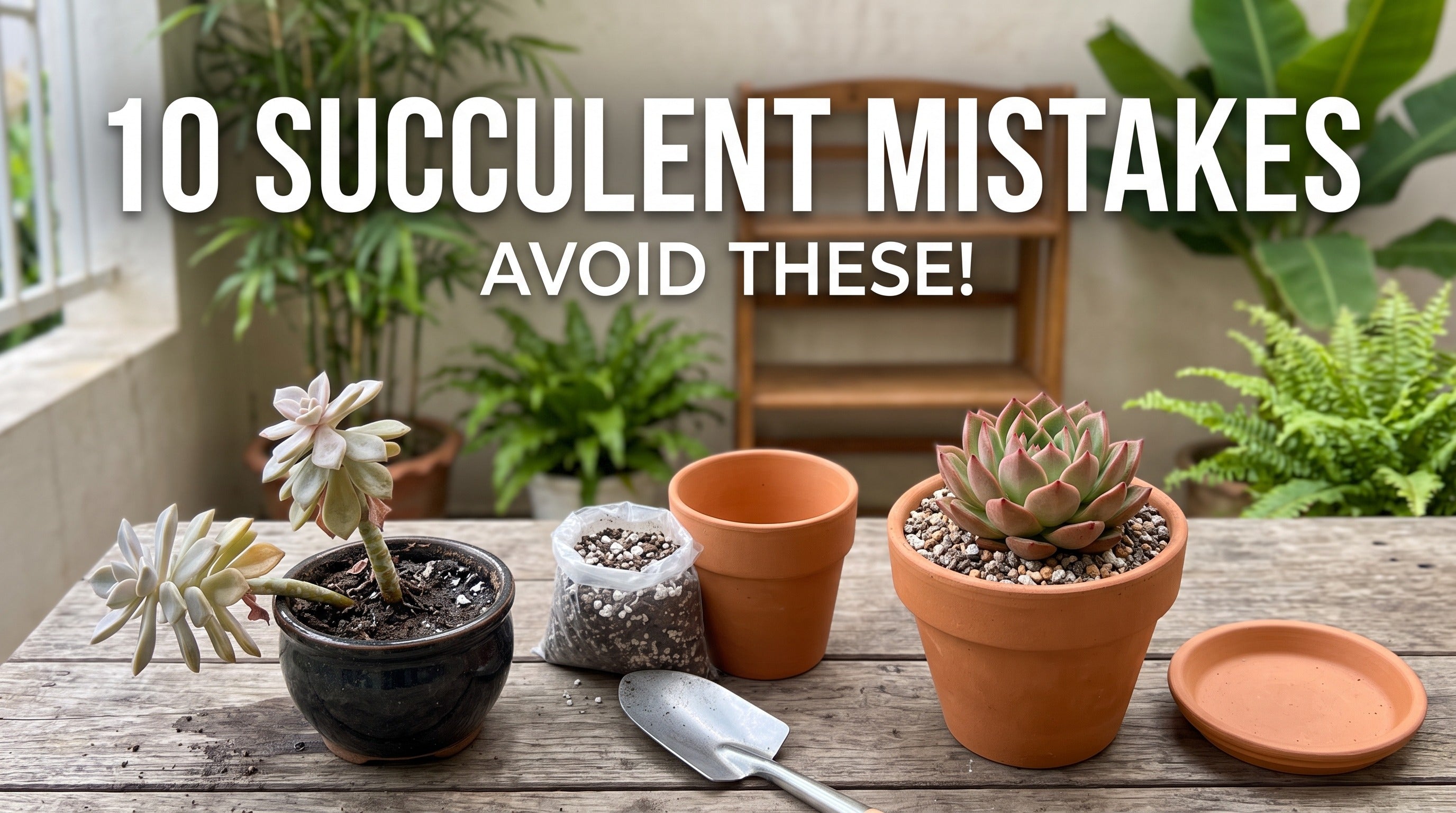
10 Common Succulent Mistakes and How to Avoid Them
Succulents are often described as easy-care plants, but that does not mean they can survive every growing condition.
Their thick, fleshy leaves and stems allow them to store water, which helps many succulent species tolerate dry periods. However, this same characteristic can make beginners more likely to overwater them or place them in conditions that are too dark or too wet. :contentReference[oaicite:1]{index=1}
If your succulent has yellowing leaves, stretched growth, soft stems, leaf drop, or roots that look unhealthy, your care routine may be the problem.
The good news is that many common succulent care mistakes are easy to correct once you understand what your plant needs.
Here are 10 common succulent mistakes beginners make and what you can do instead.
1. Overwatering Your Succulents
Overwatering is one of the most common problems with succulents.
Because succulents store water in their leaves and stems, they generally need less frequent watering than many other houseplants.
The problem is not simply giving a plant too much water at one time. Watering again before the growing medium has had time to dry can keep the roots wet for too long.
Prolonged wet conditions can damage roots and eventually contribute to root rot. :contentReference[oaicite:2]{index=2}
Instead of following a strict watering schedule, check the growing medium first.
During active growth, many indoor succulents can be watered thoroughly when the soil has dried sufficiently, allowing excess water to drain away. Watering needs can change depending on the species, season, light, temperature, and type of growing medium. :contentReference[oaicite:3]{index=3}
How to avoid this mistake:
- Check the soil before watering.
- Use a pot with drainage holes.
- Water thoroughly rather than giving tiny amounts repeatedly.
- Allow excess water to drain away.
- Reduce watering when your plant's growth slows.
Remember that there is no universal watering schedule for every succulent.
2. Using a Pot Without Drainage
A beautiful decorative pot can be tempting, but a container without a drainage hole can create problems for succulents.
When excess water has nowhere to escape, the growing medium can remain wet for too long.
Succulents generally perform best in well-draining growing media, and containers should allow excess water to escape. :contentReference[oaicite:4]{index=4}
A simple solution is to grow the plant in a nursery pot with drainage holes and place that pot inside a decorative outer container.
This allows you to keep the decorative look while still giving excess water somewhere to go.
How to avoid this mistake:
- Choose pots with drainage holes.
- Never leave the plant sitting in standing water.
- Empty excess water from saucers or decorative containers.
- Use an appropriately sized container for the plant.
Good drainage is one of the most important foundations of successful succulent care.
3. Choosing the Wrong Soil
Regular garden soil or a dense potting mix may hold more moisture than many succulents need.
Most cacti and succulents benefit from a porous, free-draining growing medium that does not stay waterlogged. :contentReference[oaicite:5]{index=5}
A suitable succulent or cactus mix can make watering much easier to manage.
If you make your own mix, the goal is to create a growing medium that drains freely rather than remaining compact and wet.
How to avoid this mistake:
- Use a well-draining succulent or cactus mix.
- Avoid heavy, compacted soil.
- Choose a mix appropriate for your particular species.
- Make sure both the container and growing medium allow excess water to escape.
Good soil does not mean soil that dries instantly. It means creating a balance that gives roots access to air while allowing excess moisture to drain away.

4. Not Giving Your Succulent Enough Light
Many succulents need abundant light to maintain healthy growth.
When a light-loving succulent is kept too far from a bright window, it may begin producing weak or stretched growth as it reaches toward available light. Insufficient light can also contribute to misshapen growth. :contentReference[oaicite:6]{index=6}
This is sometimes called etiolation.
If your normally compact succulent suddenly develops a long stem with widely spaced leaves, insufficient light may be one possible cause.
How to avoid this mistake:
- Place light-loving succulents in a bright location.
- Introduce stronger light gradually when necessary.
- Rotate the pot occasionally for more even growth.
- Observe how your particular species responds to its location.
- Consider supplemental grow lighting if natural light is insufficient.
However, more light is not always better.
Some succulent species have different light preferences, and a sudden move from low light into intense direct sunlight can stress a plant.
5. Watering on a Strict Schedule
One of the easiest succulent mistakes to make is watering every Sunday simply because it is Sunday.
Plants do not use water at exactly the same rate every week.
Watering needs can change with the season, temperature, humidity, pot size, soil composition, and amount of light.
A succulent growing in bright light may use water differently from the same species sitting in a cooler, darker room.
How to avoid this mistake:
Instead of asking, "Is it watering day?"
Ask:
"Does my plant actually need water?"
Check the growing medium and observe the plant's overall condition.
For many indoor succulents, allowing the soil to dry before watering again is an important part of preventing excessive moisture around the roots. :contentReference[oaicite:7]{index=7}
Learning to observe your plant is more useful than following an inflexible calendar.

6. Giving Too Much Fertilizer
Succulents generally have relatively low fertilizer requirements.
Adding extra fertilizer does not automatically make a plant grow faster or healthier.
Too much fertilizer can contribute to problems, particularly when the plant is not actively growing.
A better approach is to follow the instructions for the specific fertilizer and apply it at the appropriate time and dilution.
How to avoid this mistake:
- Use fertilizer sparingly.
- Follow the product label.
- Avoid heavy feeding during periods of slow growth.
- Do not assume more fertilizer means faster growth.
- Pay attention to the needs of the particular succulent species.
A healthy succulent does not need constant feeding.
7. Choosing a Pot That Is Too Large
A larger pot may seem like a good idea because the plant will have more room to grow.
For succulents, however, an oversized container can hold a larger volume of growing medium around relatively small roots.
That extra growing medium can remain wet for longer after watering.
RHS guidance specifically recommends avoiding excessively large containers because excess soil volume can stay wet and increase the risk of rot. :contentReference[oaicite:8]{index=8}
How to avoid this mistake:
- Choose a pot that is appropriately sized for the root system.
- Do not automatically move a small succulent into a very large container.
- Repot when the plant has genuinely outgrown its current container.
- Make sure the new container drains well.
When repotting, going only modestly larger is often more practical than dramatically increasing the pot size.
8. Moving a Succulent Into Strong Sun Too Quickly
Succulents often appreciate bright light, but a sudden environmental change can still cause problems.
A plant that has been growing indoors in lower light may not be ready for intense direct sunlight immediately.
Instead of moving it directly from a dim room to strong outdoor sun, gradually increase its exposure.
How to avoid this mistake:
- Introduce stronger light gradually.
- Observe the leaves for signs of stress.
- Provide appropriate protection during the transition.
- Consider the specific light requirements of the species.
A gradual transition is especially useful when moving plants outdoors after spending a long period indoors.
9. Ignoring Signs of Root Problems
Sometimes the visible symptoms of a struggling succulent can be misleading.
For example, a plant may look wilted even though the soil is wet.
That can happen when excessive moisture has damaged the root system.
Root problems may be associated with overwatering, poor drainage, or growing conditions that keep the roots wet for too long. :contentReference[oaicite:9]{index=9}
Possible warning signs include:
- Soft or mushy stems
- Unusual leaf drop
- Yellowing leaves
- Persistent wet soil
- Dark or mushy roots
- A plant that looks stressed despite wet soil
If you suspect root problems, review your watering routine, container, and growing medium.
In serious cases, inspect the roots and remove damaged material using clean tools before repotting into fresh, well-draining growing medium.
10. Treating Every Succulent the Same
"Succulent" is a broad term covering many different plants.
A desert cactus and a tropical succulent can have very different preferences.
For example, some tropical succulents can tolerate more frequent watering and lower light than many desert-adapted species.
This is why copying the exact care routine from another succulent owner may not always work for your plant.

How to avoid this mistake:
- Identify your succulent species.
- Research its natural growing environment.
- Check its light requirements.
- Learn its preferred watering pattern.
- Consider its temperature and humidity preferences.
- Adjust care based on the plant rather than the word "succulent" alone.
The more specific your plant identification is, the easier it becomes to provide appropriate care.
How to Tell if Your Succulent Needs Better Care
Your succulent can give you useful clues about its growing conditions.
If growth becomes unusually stretched, consider whether the plant is receiving enough light.
If the soil stays wet for a long time, check the container and growing medium.
If leaves become shriveled, consider whether the plant is receiving enough water, but also look at the roots and growing conditions before simply watering more.
Overwatering and underwatering can both cause problems, so it is important to consider the entire growing environment rather than diagnosing a plant from one symptom alone.
A simple weekly inspection can help you notice changes before they become serious.
Look at the leaves.
Check the soil.
Inspect the pot.
Observe new growth.
Look for insects.
Small observations can make a big difference over time.
How to Build a Better Succulent Care Routine
You do not need a complicated routine to care for most succulents.
Start with the basics.
Give the plant an appropriate amount of light.
Use a free-draining growing medium.
Choose a container with drainage.
Check the soil before watering.
Avoid leaving the plant in standing water.
Fertilize modestly when appropriate.
Observe the plant regularly.
These simple habits can prevent many of the most common succulent problems.
If you are new to growing succulents, our complete guide on how to care for succulents can also help you understand the basics of watering, light, soil, and general maintenance.
Final Thoughts
Succulents can be wonderfully rewarding plants, but "low maintenance" does not mean "no maintenance."
The most common succulent mistakes usually come from giving plants too much water, using poor drainage, providing insufficient light, choosing unsuitable soil, or assuming every succulent has exactly the same needs.
The solution is not to care for your plants less.
It is to understand what they actually need.
Pay attention to your succulent's light, soil, pot, watering habits, and overall growth.
Once you learn to read these signals, succulent care becomes much more straightforward.
With the right growing conditions and a little patience, your succulents can remain healthy, compact, and beautiful for years to come.