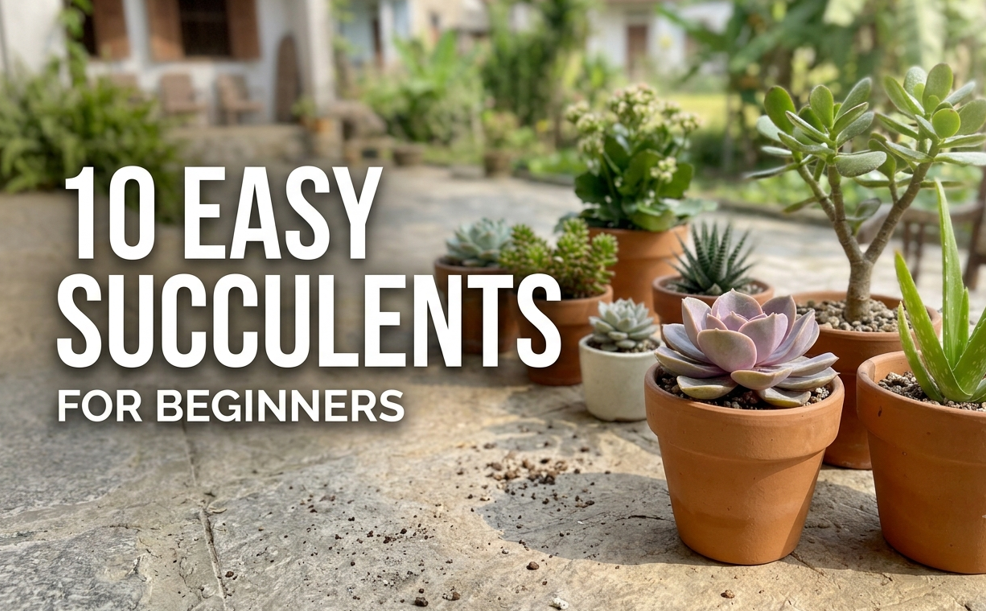
Best Succulents for Beginners: 10 Easy-to-Grow Varieties
Succulents are popular with beginner gardeners for a simple reason: many varieties are attractive, adaptable, and relatively easy to care for.
Their unusual shapes, colorful leaves, and compact growth habits make them excellent choices for windowsills, patios, containers, and outdoor gardens.
However, not every succulent is equally forgiving.
Some varieties are more sensitive to overwatering, low light, or sudden changes in temperature. If you are just starting your succulent collection, choosing an easy-to-grow variety can make the experience much more enjoyable.
In this guide, we will look at 10 of the best succulents for beginners and explain what makes each one a good choice.
What Makes a Succulent Good for Beginners?
The best beginner succulents are generally plants that can tolerate common growing mistakes and adapt to typical home conditions.
Look for varieties that are relatively tolerant of occasional missed watering, prefer well-draining soil, and can grow successfully in bright indoor or outdoor locations.
Growth rate also matters.
A slow-growing succulent may require less frequent repotting, while a faster-growing variety can provide more noticeable changes throughout the growing season.
Before choosing a plant, consider your available light, local climate, container size, and how much time you want to spend on plant care.

1. Echeveria
Echeveria is one of the most recognizable succulent groups and a favorite among beginners.
Many varieties form beautiful rosettes with leaves arranged in a symmetrical pattern.
Echeverias come in a wide range of colors, including shades of green, blue-gray, pink, purple, and red.
They are especially attractive when planted in decorative containers or arranged in a small succulent garden.
Echeverias generally prefer bright light and well-draining soil.
The most important beginner lesson is to avoid keeping the soil constantly wet.
Allow the soil to dry between waterings and make sure excess water can drain freely from the container.
Why Beginners Like Echeveria:
- Attractive rosette shape
- Many colors and varieties
- Easy to display in containers
- Compact growth
- Great for succulent arrangements
2. Haworthia
Haworthia is an excellent option for beginners who want a smaller succulent that can adapt well to indoor growing.
Many Haworthia varieties have distinctive striped, spotted, or textured leaves.
Their compact size makes them ideal for windowsills, desks, shelves, and small containers.
Compared with many other succulents, Haworthia can tolerate slightly lower indoor light conditions, although bright indirect light is still preferable.
Water when the soil has dried sufficiently and avoid leaving the plant sitting in water.
Why Beginners Like Haworthia:
- Compact size
- Interesting leaf patterns
- Good indoor option
- Relatively low maintenance
- Great for small spaces
3. Aloe Vera
Aloe vera is one of the most familiar succulents and can be an excellent beginner plant.
Its long, fleshy leaves grow from a central base and can eventually produce offsets around the parent plant.
Aloe vera generally prefers bright light and well-draining soil.
Allow the soil to dry between waterings and avoid excessive moisture around the roots.
A mature Aloe vera can also produce new pups, which means beginners may eventually have opportunities to propagate additional plants.
Why Beginners Like Aloe Vera:
- Familiar and easy to recognize
- Attractive upright growth
- Produces offsets
- Works well in containers
- Relatively easy to maintain

4. Jade Plant
The Jade Plant, commonly known as Crassula ovata, is another popular choice for new succulent growers.
It develops thick, rounded leaves and can gradually form a small tree-like shape with a sturdy stem.
With the right conditions, a jade plant can live for many years.
Place it in a bright location and use a well-draining potting mix.
Like many succulents, jade plants are more likely to suffer from excessive watering than from being slightly too dry.
One advantage of the jade plant is that its woody growth can eventually give it a miniature tree appearance.
Why Beginners Like Jade Plants:
- Long-lived
- Attractive rounded leaves
- Easy to propagate
- Can develop a tree-like form
- Excellent container plant
5. Sedum
Sedum includes many different succulent species with a wide range of growth habits.
Some remain compact and upright, while others spread or trail over the edge of containers.
This variety makes Sedum useful for hanging containers, rock gardens, succulent arrangements, and outdoor spaces.
Many Sedum varieties grow quickly when they receive sufficient light and are planted in well-draining soil.
Because the group is so diverse, always check the specific needs of the variety you choose.
Why Beginners Like Sedum:
- Many varieties available
- Different shapes and growth habits
- Good for containers
- Some varieties spread or trail
- Easy to combine with other succulents
6. Sempervivum
Sempervivum is commonly called Hens and Chicks because mature rosettes produce smaller offsets around the parent plant.
These small offsets can create attractive clusters over time.
Sempervivum is particularly useful for outdoor succulent gardens and rock gardens in suitable climates.
It prefers plenty of light and excellent drainage.
Because individual varieties can differ in cold tolerance, check the needs of your specific plant before leaving it outdoors year-round.
Why Beginners Like Sempervivum:
Produces many offsets
- Attractive rosette clusters
- Great for rock gardens
- Interesting growth habit
- Can form large colonies over time

7. Graptopetalum
Graptopetalum is another excellent choice for beginners who enjoy colorful rosette-shaped succulents.
Many varieties develop pale, powdery leaves in shades of gray, blue, pink, or lavender when grown under suitable conditions.
These plants can look especially beautiful when exposed to bright light.
Graptopetalum also works well in containers and succulent arrangements.
Avoid excessive watering and give the plant a well-draining growing medium.
Why Beginners Like Graptopetalum:
- Beautiful pastel colors
- Attractive rosette shape
- Easy to grow in containers
- Works well in succulent arrangements
- Can produce offsets
8. Gasteria
Gasteria is known for its thick, textured leaves and compact growth habit.
Many varieties have dark green leaves covered with attractive spots or patterns.
Gasteria can be a good choice for indoor gardeners because it generally prefers bright indirect light rather than intense direct sunlight all day.
It still needs good drainage and should not be kept constantly wet.
Its compact form makes it suitable for shelves, windowsills, and small containers.
Why Beginners Like Gasteria:
- Compact growth
- Attractive leaf patterns
- Good indoor option
- Tolerates bright indirect light
- Relatively easy to maintain
9. Kalanchoe
Kalanchoe is a diverse group of succulents that includes several popular houseplants.
Some varieties are especially attractive because they can produce colorful flowers under suitable growing conditions.
Kalanchoe generally prefers bright light and well-draining soil.
Be careful not to overwater the plant, especially when it is growing indoors in a container with limited airflow.
With appropriate light and care, Kalanchoe can add both foliage and seasonal color to a succulent collection.
Why Beginners Like Kalanchoe:
- Attractive flowers on some varieties
- Colorful appearance
- Works well in containers
- Good indoor growing option
- Interesting foliage
10. String of Pearls
String of Pearls, or Curio rowleyanus, is a distinctive trailing succulent with round, bead-like leaves.
Its unusual appearance makes it especially popular in hanging baskets and elevated containers.
It can be slightly more challenging than some of the other plants on this list, but it can still be a good beginner choice when given the right conditions.
The most important factors are bright light, excellent drainage, and careful watering.
Avoid keeping the growing medium constantly wet.
Why Beginners Like String of Pearls:
- Unique trailing appearance
- Excellent for hanging containers
- Compact root system
- Visually distinctive
- Great conversation plant
Which Succulent Is Easiest for a Beginner?
If you are completely new to succulent care, several varieties are particularly approachable.
Haworthia is a good choice for a small indoor space.
Aloe vera is useful for beginners who want a familiar plant with upright growth.
Jade plants are excellent for people who want a long-lived succulent that can eventually develop a small tree-like form.
Echeveria is a great option if appearance is your priority.
For outdoor gardens, Sempervivum and suitable Sedum varieties can be excellent choices depending on your local climate.
The easiest plant for you will ultimately depend on the growing conditions you can provide.
Indoor vs. Outdoor Succulents
Not all succulents should be treated exactly the same way.
Indoor growing usually means lower light levels, less airflow, and containers that may dry more slowly.
Outdoor growing can provide stronger light and better airflow, but plants may also experience rain, heat, cold, and temperature fluctuations.
Before placing a succulent outdoors permanently, check whether the variety is suitable for your local climate.
For indoor plants, place succulents near a bright window or provide suitable supplemental lighting if natural light is insufficient.
How Much Light Do Beginner Succulents Need?
Most succulents prefer plenty of light, but the exact amount depends on the variety.
A bright window can work well for many indoor succulents.
However, plants that have been growing indoors should not always be moved suddenly into intense direct sunlight.
A gradual transition can help reduce the risk of sun stress or leaf damage.
Watch the plant for changes.
Stretching or elongated growth can indicate insufficient light, while sudden discoloration or scorched patches may indicate excessive exposure.
Choosing the Right Soil
Good drainage is one of the most important factors in succulent care.
Succulents generally do better in a growing medium that allows excess water to move away from the roots.
Avoid heavy garden soil that stays wet for long periods in containers.
A commercial succulent and cactus mix can be a convenient starting point for beginners.
You can also improve drainage by choosing an appropriate container and ensuring it has a drainage hole.
Choosing the Right Pot
A pot with a drainage hole is usually the safest choice for beginner succulent growers.
The container should be large enough to accommodate the plant's roots without being unnecessarily oversized.
Very large containers can hold more moisture around the roots for longer periods.
Terracotta pots are popular because they are porous and can allow moisture to evaporate through the sides.
However, the most important factor is still proper watering and well-draining soil.
Common Beginner Mistakes
Even easy-to-grow succulents can struggle when their basic needs are overlooked.
One of the most common problems is overwatering.
Another is insufficient light.
Other common mistakes include using heavy soil, choosing containers without drainage holes, placing plants in unsuitable temperatures, and watering on a rigid schedule without checking the soil.
If you are learning how to care for your new plants, understanding when to water is especially important. Our guide to How Often Should You Water Succulents? A Simple Guide can help you develop a better watering routine.
How to Build a Beginner Succulent Collection
You do not need to buy ten plants at once.
Start with two or three varieties that match your growing conditions.
For example, you could combine an Echeveria, Haworthia, and Jade Plant for an indoor collection.
If you have a suitable outdoor space, Sempervivum and Sedum can create an attractive combination.
Pay attention to the light and watering needs of each plant rather than grouping succulents only because they look good together.
As you gain experience, you can gradually add more unusual varieties.

Best Succulents for Beginners at a Glance
Echeveria:
Best for beautiful rosettes and colorful containers.
Haworthia:
Best for compact indoor spaces.
Aloe Vera:
Best for beginners who want a familiar upright succulent.
Jade Plant:
Best for a long-lived, tree-like succulent.
Sedum:
Best for variety and spreading or trailing growth.
Sempervivum:
Best for outdoor rosette clusters.
Graptopetalum:
Best for pastel-colored rosettes.
Gasteria:
Best for patterned leaves and indoor growing.
Kalanchoe:
Best for colorful flowers and attractive foliage.
String of Pearls:
Best for hanging containers and trailing displays.
Final Thoughts
Choosing the best succulents for beginners does not have to be complicated.
The key is to select plants that match your available light, space, climate, and watering habits.
Echeveria, Haworthia, Aloe vera, Jade Plant, Sedum, Sempervivum, Graptopetalum, Gasteria, Kalanchoe, and String of Pearls all offer something different for a new gardener.
Start with varieties that fit your environment rather than choosing a plant simply because it looks interesting.
Once you understand the basics of light, drainage, soil, and watering, you can gradually expand your collection.
With the right beginner-friendly succulents, growing a beautiful collection can be simple, rewarding, and surprisingly enjoyable.