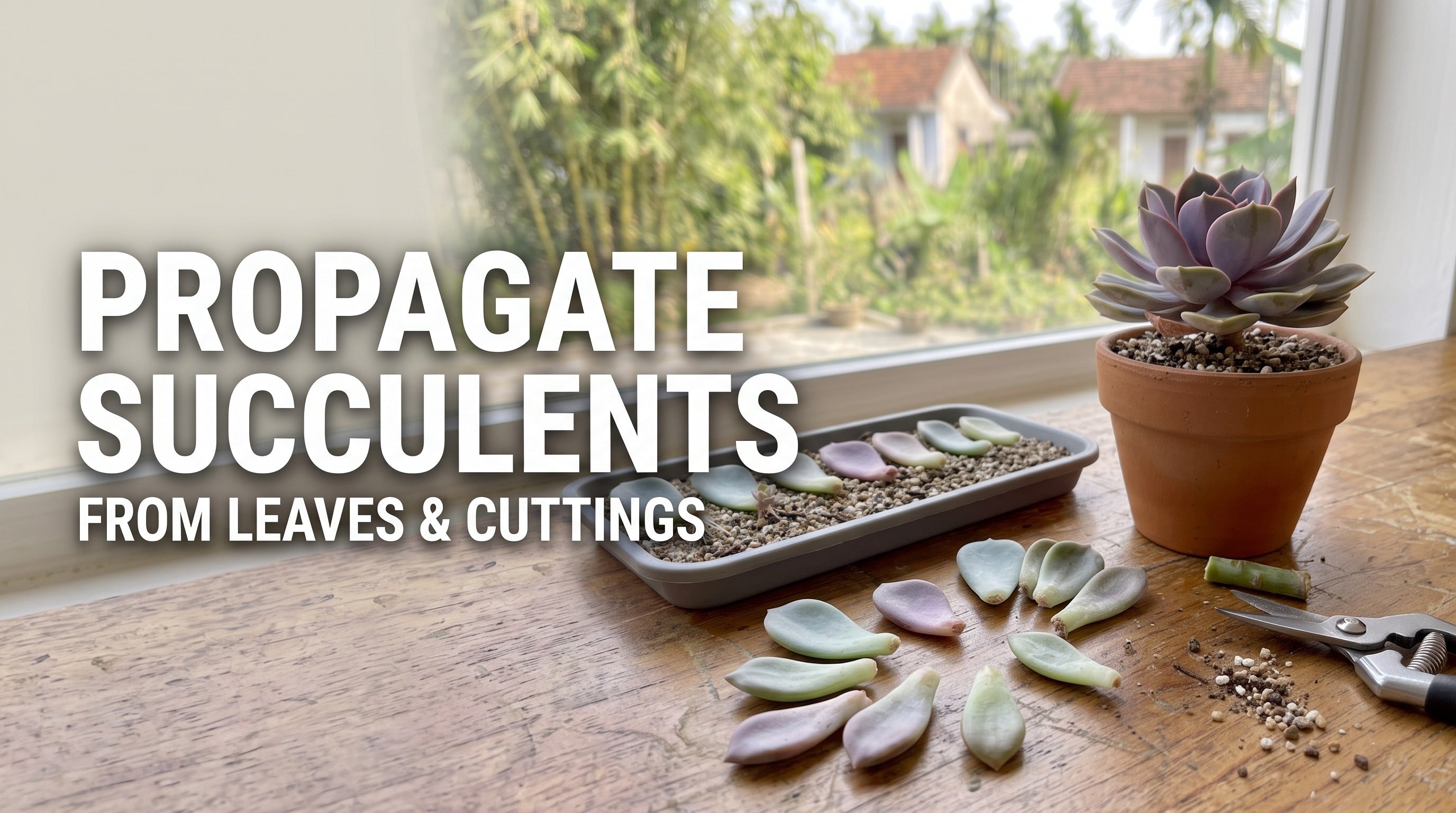
How to Propagate Succulents from Leaves and Cuttings
One of the most rewarding things about growing succulents is discovering that you can create new plants from the ones you already have.
A healthy succulent leaf or stem cutting can sometimes develop roots and new growth, allowing you to expand your collection without buying another mature plant.
Succulent propagation can seem complicated at first, but the basic process is surprisingly simple.
The key is choosing the right plant material, making clean cuts, allowing wounds to dry properly, using a well-draining growing medium, and giving new cuttings the right amount of light and moisture.
In this guide, you will learn how to propagate succulents from leaves and stem cuttings, including what to prepare, how to start each method, and how to care for new roots and baby plants.
Can All Succulents Be Propagated From Leaves?
Not every succulent responds to leaf propagation in the same way.
Leaf propagation tends to work best with plants that have thick, fleshy leaves and can produce new growth from the leaf base. Echeveria, Sedum, Graptopetalum, and Pachyphytum are examples of succulent groups that can be good candidates.
Other succulents are better propagated through stem cuttings, offsets, or division.
This is why it is important to identify your succulent before choosing a propagation method.
If you are still deciding which plants are easiest to grow, our guide to Best Succulents for Beginners: 10 Easy-to-Grow Varieties can help you choose beginner-friendly varieties for your collection.
What You Need for Succulent Propagation
You do not need a large collection of gardening tools to propagate succulents.
For leaf propagation, you may need:
- Healthy succulent leaves
- A shallow tray or small container
- Well-draining succulent or cactus potting mix
- A clean, dry surface
- Bright indirect light
For stem cuttings, prepare:
- A healthy succulent
- Clean, sharp pruning shears or scissors
- A small container
- Well-draining succulent soil
- A clean tray or surface for callusing
Clean tools are especially important when making stem cuts because they help create a clean wound and reduce the chance of introducing contaminants.
Method 1: How to Propagate Succulents From Leaves
Leaf propagation is one of the most popular ways to multiply certain succulent varieties.
The process is slower than growing from a stem cutting, but it can be fascinating because you can watch roots and tiny new growth develop from a single leaf.
Step 1: Choose a Healthy Leaf
Start with a healthy, plump leaf.
Avoid leaves that are already damaged, extremely shriveled, yellowing, or showing signs of rot.
A strong leaf contains stored moisture and energy that can help support new growth.
Look for a mature leaf that is still firm and healthy.
Step 2: Remove the Leaf Cleanly
Hold the leaf close to the stem and gently twist it from side to side.
The goal is to remove the entire leaf cleanly from the stem.
The small area where the leaf connects to the stem is important because new roots and growth can develop from this tissue.
If the leaf breaks in the middle or part of the base remains attached to the mother plant, it may be less likely to propagate successfully. :contentReference[oaicite:1]{index=1}
Do not pull aggressively.
A gentle twisting motion is usually better than forcing the leaf away from the plant.
Step 3: Let the Leaf Callus
After removing the leaf, do not immediately place it into wet soil.
Set it somewhere dry with good airflow and allow the damaged end to dry and form a callus.
The exact time varies depending on the environment and the size of the wound, but several days is common.
Callusing allows the wound to dry before the leaf is exposed to moisture, which can help reduce the risk of rot. :contentReference[oaicite:2]{index=2}
Patience is important during this stage.

Step 4: Place the Leaf on Succulent Soil
Once the end has dried, place the leaf horizontally on top of a well-draining succulent or cactus growing medium.
Do not bury the entire leaf.
The base where the leaf was attached should remain close to the surface so that new roots and growth can develop.
A shallow propagation tray works well because you do not need a large amount of soil for individual leaves.
Step 5: Provide Bright Indirect Light
Place the propagation tray somewhere bright but protected from intense direct sunlight.
Newly propagating leaves are more delicate than established plants.
Too much harsh sunlight can cause the leaf to dry out before it has a chance to develop new growth.
A bright windowsill with filtered light or another bright indoor location can work well.
Step 6: Be Careful With Moisture
One of the biggest mistakes beginners make is keeping propagation material too wet.
Succulent leaves already contain stored moisture, so they do not need to sit in wet soil.
Keep the environment lightly moist rather than saturated, and avoid repeatedly soaking the propagation tray.
Excess moisture can encourage rot, especially before roots have developed.
Step 7: Wait for Roots and New Growth
This is where patience becomes important.
Depending on the succulent, temperature, light, and growing conditions, roots and baby plants may take weeks to appear.
You may first notice tiny roots emerging from the leaf base.
Later, a small rosette or baby plant can begin developing.
Do not rush to remove the original leaf.
The parent leaf can continue providing stored resources to the developing plantlet until it gradually shrivels.

Method 2: How to Propagate Succulents From Stem Cuttings
Stem cuttings are another effective way to propagate many succulents.
This method can be particularly useful when a succulent has become tall, stretched, or leggy.
A stem cutting can also give you a larger starting plant than leaf propagation.
Step 1: Choose a Healthy Stem
Select a healthy section of stem with firm leaves and no obvious signs of rot or disease.
If your succulent has become unusually tall or stretched, propagation can also be an opportunity to reshape the mother plant.
Choose a section that has enough stem to place securely into the growing medium.
Step 2: Make a Clean Cut
Use clean, sharp pruning shears or scissors to make a clean cut.
Avoid crushing or tearing the stem.
For many succulent stem cuttings, a few inches of stem can provide a useful starting point, although the appropriate cutting size depends on the plant.
After making the cut, remove a few lower leaves if necessary so that the portion of stem going into the growing medium is free of leaves.
Step 3: Let the Cutting Callus
This step is extremely important.
Do not immediately plant a freshly cut succulent stem into wet soil.
Place it on a clean, dry surface and allow the cut end to dry and form a callus.
The time required varies depending on the plant and environmental conditions, but several days is a common starting point.
A properly callused cutting is better prepared for planting because the fresh wound has had time to dry. :contentReference[oaicite:4]{index=4}
Step 4: Prepare a Well-Draining Growing Medium
Use a growing medium designed for succulents and cacti.
The goal is to provide good drainage and avoid keeping the cutting constantly wet.
Choose a container with drainage holes so excess moisture can escape.
This is especially important during propagation because overly wet conditions can encourage stem rot.
Step 5: Plant the Cutting
Once the cut end has callused, place the stem cutting into the growing medium.
Insert only enough of the stem to keep the cutting stable.
Do not bury a large portion of the stem.
If necessary, gently press the soil around the base so the cutting remains upright.
Step 6: Give It the Right Light
Place the cutting in a bright location with indirect or filtered light.
Avoid immediately putting a fresh cutting into intense direct sunlight.
The goal is to provide enough light to support rooting without creating excessive stress.
Step 7: Water Carefully
Watering should be conservative during the early stage.
Avoid keeping the growing medium constantly wet.
Once roots begin developing, you can gradually transition the new plant toward a more normal succulent watering routine.
Remember that newly propagated plants can be more sensitive to excessive moisture than established succulents.
Leaf Propagation vs. Stem Cuttings
Both methods can work well, but they are useful in different situations.
Leaf propagation is ideal when you have a suitable succulent variety and want to create multiple small plants.
Stem cuttings are often faster when you want to establish a larger plant or reshape a stretched succulent.
Leaf propagation:
- Uses individual leaves
- Requires very little plant material
- Can produce multiple baby plants
- Usually takes longer
- Works best with suitable leaf-propagating varieties
Stem cuttings:
- Uses a section of stem
- Can produce a larger starting plant
- Useful for leggy or overgrown succulents
- Often establishes faster than individual leaves
- Works with many branching or stem-forming succulents
Neither method is automatically better.
The best choice depends on the species and the result you want.
Common Succulent Propagation Mistakes
Propagating succulents is relatively simple, but beginners often make a few avoidable mistakes.
Using Damaged Leaves
A damaged or unhealthy leaf is less likely to produce strong new growth.
Start with healthy, plump material whenever possible.
Skipping the Callusing Stage
Fresh cuts should have time to dry before being exposed to moisture.
Planting a fresh, wet cutting directly into moist soil can increase the risk of rot.
Using Too Much Water
More water does not necessarily mean faster rooting.
Succulents store water naturally, and excess moisture can create problems during propagation.
Burying Leaves Too Deeply
Leaf cuttings should generally rest on top of the growing medium rather than being buried.
The leaf base needs access to air and space for roots and new growth to develop.
Using Poorly Draining Soil
Heavy soil can hold too much moisture around developing roots and cuttings.
A well-draining succulent or cactus mix is a better starting point.
Moving Cuttings Too Often
It can be tempting to check your propagation tray every day.
However, repeatedly moving leaves or cuttings can disturb fragile roots as they begin to develop.
Give them time.
Not Enough Light
Propagation does not mean the plant should be kept in a dark corner.
Bright indirect light can support healthy development while reducing the stress associated with harsh direct sunlight.
How Long Does Succulent Propagation Take?
There is no single timeline for every succulent.
Leaf propagation can take several weeks or longer before you see obvious roots and baby plants.
Stem cuttings may establish more quickly, depending on the plant and growing conditions.
Temperature, light, humidity, season, species, and the health of the cutting can all affect the process.
Instead of expecting a specific number of days, look for signs of progress.
New roots, fresh leaves, or a small baby rosette are all encouraging signs.
What to Do When Roots Appear
Once roots begin developing, continue providing appropriate light and careful moisture.
For leaf propagation, allow the baby plant to develop before separating it from the original leaf.
For stem cuttings, gently check for resistance rather than repeatedly pulling the cutting from the soil.
Once the plant has established a healthy root system and is actively growing, it can gradually transition into a more typical succulent care routine.
When to Move a New Succulent Into Its Own Pot
Do not rush to move a newly developing plant into a large container.
Small plants generally need only a small amount of growing medium.
Once the new succulent has developed a stronger root system and enough growth to handle transplanting, move it carefully into an appropriately sized container with drainage.
Choose a pot that is only slightly larger than the root system.
A very large pot can hold more moisture than the young plant needs.
Tips for Successful Succulent Propagation
Start with healthy parent plants.
Use clean tools when taking stem cuttings.
Choose the correct propagation method for the species.
Allow fresh cuts to callus.
Use a well-draining growing medium.
Provide bright indirect light.
Avoid excessive moisture.
Give developing roots time to establish.
Do not disturb cuttings unnecessarily.
Most importantly, be patient.
Propagation is a process rather than an instant result.

Final Thoughts
Learning how to propagate succulents from leaves and cuttings is a simple way to expand your collection and make the most of healthy plants you already own.
Leaf propagation can be an enjoyable way to watch tiny roots and baby rosettes develop from individual leaves.
Stem cuttings can be especially useful for larger, stretched, or branching succulents.
The most important habits are simple: choose healthy plant material, make clean cuts, allow wounds to callus, use well-draining soil, provide appropriate light, and avoid excessive moisture.
Once you understand these basics, succulent propagation becomes much less intimidating.
With patience and the right conditions, a single healthy succulent can become the beginning of an entirely new collection.