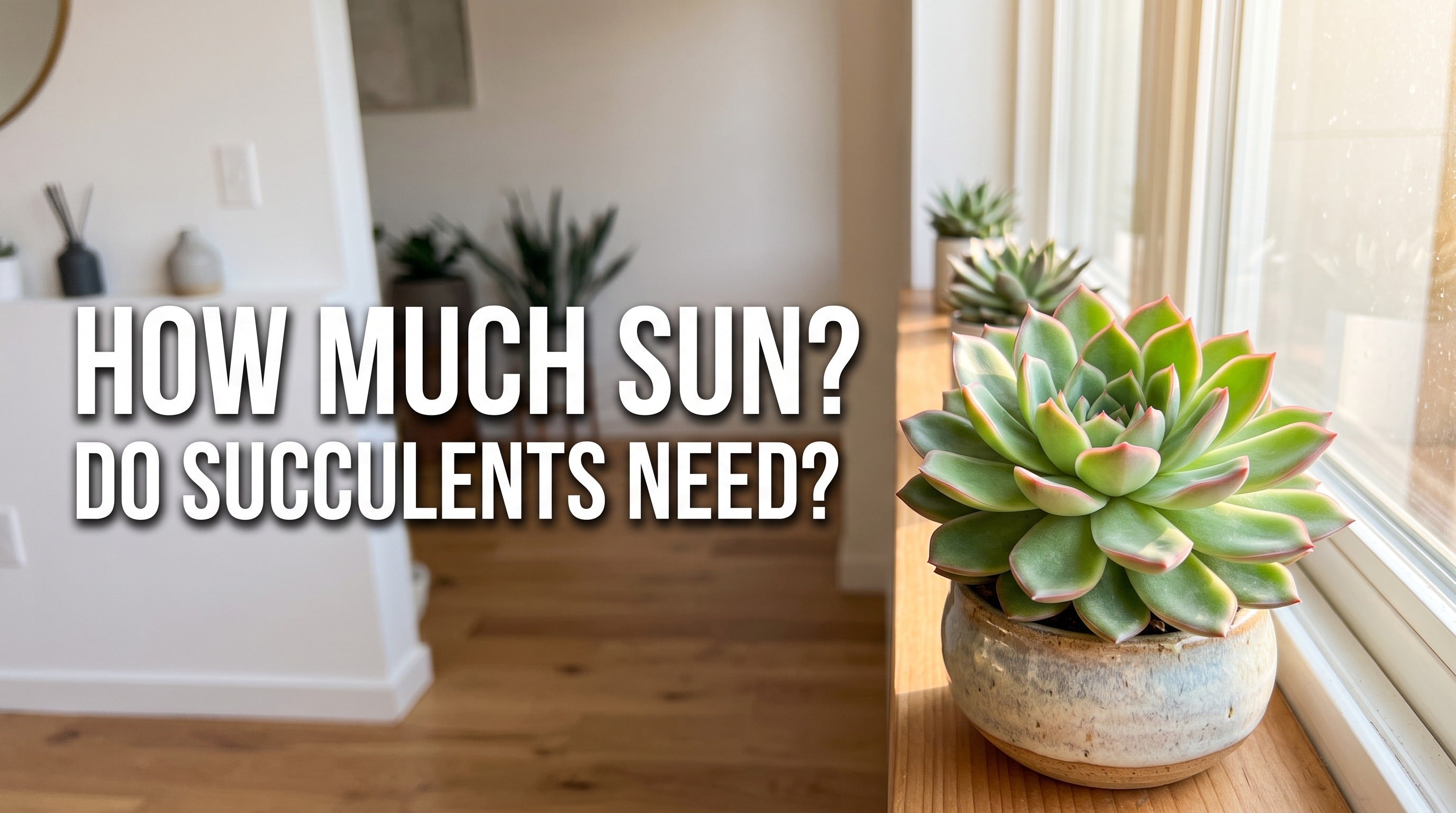
How Much Sunlight Do Succulents Need? A Complete Light Guide
If your succulent is growing slowly, stretching toward a window, losing its shape, or developing pale leaves, the problem may not be watering or soil.
It could be light.
Understanding how much sunlight succulents need is one of the most important parts of keeping these plants healthy. Although many succulents are famous for loving bright, sunny conditions, not every succulent needs the same amount of direct sunlight.
Some thrive in several hours of direct sun, while others prefer bright filtered light or partial shade.
The right amount of light depends on the type of succulent, whether it is growing indoors or outdoors, the season, and how gradually the plant has been introduced to stronger sunlight.
In this complete guide, you will learn how much sunlight succulents generally need, how to recognize too little or too much light, where to place indoor succulents, and how to safely increase their exposure to direct sun.

Why Do Succulents Need So Much Light?
Succulents have adapted to environments where sunlight can be intense.
Their fleshy leaves and stems allow them to store water, while sunlight provides the energy needed for photosynthesis and growth.
Many common cacti and succulents therefore perform best in bright locations. The University of Minnesota Extension recommends placing succulents in a bright, sunny window when growing them indoors.
The Royal Horticultural Society also notes that most cacti and succulents are sun-lovers and generally thrive on sunny windowsills, although some exceptions prefer semi-shade.
This does not mean that every succulent should immediately be placed in the strongest possible sunlight.
A plant that has been growing indoors in relatively low light can be damaged if it is suddenly moved into intense outdoor sun.
The goal is not simply maximum sunlight.
The goal is the right amount of light for your particular succulent.
How Much Sunlight Do Succulents Need?
As a general starting point, many light-loving succulents do well with several hours of bright light each day, including some direct sunlight.
However, there is no single number of hours that works for every succulent.
A plant's light needs depend on its species and growing environment.
Some desert-type succulents and cacti can tolerate strong direct sun once properly acclimated.
Other succulents, especially those adapted to more protected environments, may perform better with bright indirect light or partial shade.
Instead of following a strict number of hours, pay attention to how the plant responds.
Healthy growth, compact form, and good coloration are useful clues that the plant is receiving an appropriate amount of light.
If your succulent begins stretching toward a light source, the plant may need more light.
If leaves develop bleached, crispy, or scorched areas after a sudden move into intense sun, the plant may be receiving too much light too quickly.
The Best Type of Light for Succulents
When people talk about sunlight, they often focus only on the number of hours.
But light intensity and exposure are equally important.
There is a major difference between:
- Bright direct sunlight
- Bright filtered sunlight
- Bright indirect light
- Low light
Most common succulents prefer bright conditions.
A sunny windowsill can provide excellent light indoors.
However, the amount of light entering a room can change dramatically depending on window direction, curtains, nearby buildings, trees, and the season.
A plant sitting several feet away from a bright window may receive much less usable light than a plant sitting directly beside the window.
This is why a room that looks bright to your eyes can still be relatively low-light for a succulent.
Light intensity also changes with the seasons. The Royal Horticultural Society notes that sunlight is weaker in winter than in summer, which can affect how much light plants receive.
Indoor Succulent Light Requirements
Growing succulents indoors can be very successful if you provide enough light.
For many common varieties, the brightest window in your home is usually a good place to start.
South-facing windows often provide strong light, while east- and west-facing windows can also work well depending on the plant and local conditions.
North-facing windows generally provide less direct sunlight.
However, window direction alone does not tell the entire story.
A south-facing window with sheer curtains may provide very different light from an uncovered south-facing window.
Likewise, an east-facing window in one home may receive much more direct sunlight than an east-facing window blocked by another building.
Watch the plant rather than relying only on the compass direction.
If the plant stays compact and maintains healthy growth, the location may be working well.
If it begins leaning or stretching toward the window, consider moving it closer to the light source.
Can Succulents Grow in Low Light?
Some succulents can tolerate lower light better than others, but most common succulents are not ideal plants for dark corners.
Low light can cause several problems.
A succulent may begin growing toward the nearest window.
Its stem may become longer and thinner.
Leaves may become more widely spaced.
The plant can lose the compact appearance that made it attractive in the first place.
This stretched growth is commonly called etiolation.
The Royal Horticultural Society identifies insufficient light as a cause of weak or misshapen succulent growth.
If your succulent is stretching, moving it closer to a bright window may help prevent additional weak growth.
Unfortunately, previously stretched growth will not always return to its original compact shape.
That is why catching insufficient light early is helpful.
Signs Your Succulent Is Not Getting Enough Light
Your succulent may need more light if you notice:
- Long, stretched growth
- Large gaps between leaves
- Leaning toward a window
- Pale or faded coloration
- Slow or weak growth
- A rosette becoming more open
- New growth developing mostly on one side
One of the clearest signs is directional growth.
If your plant is obviously reaching toward a window, it is telling you where the light is coming from.
Rotating the pot periodically can help distribute light more evenly, but rotation is not a substitute for adequate light.
If the location itself is too dim, moving the plant closer to a brighter window is usually more useful.

Can Succulents Get Too Much Sun?
Yes.
Although many succulents tolerate strong sunlight, too much intense sunlight can cause damage, especially when a plant is suddenly exposed to conditions it is not accustomed to.
Sunburn can appear as:
- Pale patches
- Tan or brown spots
- Dry, crispy areas
- Bleached sections
- Discolored leaves
The important point is that sunburn is not necessarily caused simply by sunlight being "bad" for the plant.
It can happen when the intensity of light changes too quickly.
A succulent that has been living indoors behind glass may not be ready for several hours of intense outdoor sun.
This is why gradual acclimation is important.
The University of Minnesota Extension specifically recommends transitioning succulents gradually when moving them outdoors because direct sunlight can burn plants that are not acclimated.
How to Acclimate Succulents to More Sunlight
If you want to move an indoor succulent outdoors, do not place it immediately in the strongest afternoon sun.
Start with a protected location.
A spot with bright indirect light or gentle morning sun can be a better starting point.
Then gradually increase exposure over time.
For example:
Day 1–3:
Place the plant in bright filtered light.
Day 4–6:
Introduce a little more morning sunlight.
Day 7 onward:
Gradually increase direct sunlight while watching the leaves.
The exact schedule can vary depending on the plant, climate, season, and intensity of sunlight.
If the leaves begin showing signs of stress, reduce the exposure and allow the plant more time to adjust.
This gradual approach is especially important in climates with intense summer sunlight.

Morning Sun vs. Afternoon Sun
Not all direct sunlight is equally intense.
Morning sunlight is often gentler than strong midday or afternoon sun.
This can make morning sun a useful starting point when acclimating indoor succulents to outdoor conditions.
The University of Minnesota Extension advises protecting plants from intense midday exposure when transitioning them outdoors.
Once properly acclimated, many sun-loving succulents can handle significantly more direct light.
But again, the plant variety matters.
Some succulents naturally prefer partial shade.
Others are much more comfortable in full sun.
Understanding the individual plant is more important than following a universal rule.
Which Window Is Best for Succulents?
For many indoor succulents, a bright south-facing window can be an excellent choice.
However, east- and west-facing windows can also work very well.
Here is a simple starting point:
South-facing window:
Usually the strongest indoor light and often a good choice for sun-loving succulents.
East-facing window:
Provides gentle morning sun and can work well for many varieties.
West-facing window:
Provides stronger afternoon light and may work well for plants that tolerate more sun.
North-facing window:
Usually provides less direct sunlight and may be insufficient for many light-loving succulents.
Remember that these are starting points rather than strict rules.
Buildings, trees, balconies, curtains, and seasonal changes can dramatically alter the amount of sunlight reaching your plants.
Should You Rotate Your Succulents?
Rotating your succulent can help the plant receive light more evenly.
If one side of the plant faces a window continuously, the plant may grow more strongly toward that direction.
A gentle rotation every week or two can help maintain a more balanced shape.
However, if the plant is stretching significantly, rotating it will not solve the underlying problem.
The plant probably needs a brighter location.
Think of rotation as a way to distribute light, not as a replacement for sufficient light.
Succulents and Artificial Grow Lights
Sometimes natural sunlight is simply not enough.
This can happen when:
- Your home has limited windows
- Your windows face a shaded area
- You live in a region with short winter days
- Your succulent collection is located away from windows
- You want to grow plants in a darker room
Artificial grow lights can supplement natural light.
The University of Minnesota Extension notes that artificial lighting can make up for insufficient natural light for succulents.
For a small collection, a dedicated grow light can be a practical solution.
Positioning and timing matter, so follow the manufacturer's recommendations for the specific light you use.
Avoid assuming that simply placing a very strong light extremely close to the plant is always better.
The goal is consistent, appropriate light without excessive heat or leaf damage.
How Light Changes Throughout the Year
Your succulent's light requirements do not exist in isolation from the seasons.
A location that works beautifully in summer may provide much less light during winter.
Winter days are shorter, and sunlight can be weaker.
As a result, some succulents may naturally slow their growth during darker months.
You may notice:
- Slower growth
- Less vibrant coloration
- More open growth
- Increased stretching
- Soil staying wet longer
This is a good time to reassess your plant's location.
Moving a succulent closer to a bright window or using supplemental grow lighting may help maintain better conditions.
However, avoid responding to low winter light by dramatically increasing watering.
Succulents generally use less water when growth and light levels are lower.
Light and Watering Are Connected
One of the most important things to understand about succulent care is that light and watering are connected.
When light levels are high and the plant is actively growing, it may use water more quickly.
When light levels are low, growth can slow and the soil may remain wet longer.
The University of Minnesota Extension notes that succulent watering needs change with light levels and recommends allowing the soil to dry between waterings.
This means you should not create a watering schedule based only on the calendar.
Instead, consider:
- Light level
- Temperature
- Season
- Pot size
- Soil drainage
- Plant variety
- Current growth
If you move a succulent from a bright sunny window to a darker location, its watering needs may change.
How to Find the Right Light for Your Succulent
If you are unsure whether your plant is receiving enough light, start by observing it.
Ask yourself:
Is the plant growing compactly?
Is it leaning toward the window?
Are new leaves becoming smaller or more widely spaced?
Are the colors changing?
Are there signs of sunburn?
Is the plant growing normally for its variety?
These observations can tell you more than simply counting sunlight hours.
If the plant is stretching, gradually increase light.
If it develops signs of sun damage after a sudden move, reduce the intensity and acclimate more slowly.
Remember that a healthy succulent does not always look exactly the same in every season.
Some species naturally change color when exposed to stronger light.
For example, certain succulents can develop red or pink coloration under stronger light conditions. Individual species vary considerably, so learn the normal appearance of the specific plant you are growing.
Common Light Mistakes Beginners Make
Several common mistakes can make succulent care more difficult.
Mistake 1: Keeping succulents in a dark room
Succulents may survive for a while in low light, but many will eventually become stretched or weak.
Mistake 2: Moving a plant directly from indoors to intense outdoor sun
This can cause sunburn.
Mistake 3: Assuming every succulent needs full sun
Many do enjoy strong light, but some varieties prefer partial shade or filtered light.
Mistake 4: Looking only at the room, not the plant
A room can look bright to you while providing inadequate light for a succulent.
Mistake 5: Watering on a fixed schedule after changing light conditions
Moving a plant to a different light level can change how quickly its soil dries.
Mistake 6: Ignoring seasonal changes
A sunny summer window may provide much less usable light during winter.
Mistake 7: Treating sunburn by immediately watering more
Sunburn is a light-exposure problem, not automatically a sign that the plant needs more water.
A Simple Light Guide for Beginners
If you want an easy starting point, use this approach.
Bright direct light:
Best for many sun-loving succulents and cacti.
Bright filtered light:
Useful for plants that prefer protection from intense midday sun.
Bright indirect light:
Can work for some less sun-loving succulents and indoor conditions.
Low light:
Usually not ideal for most common succulents and may lead to stretching.
The exact preference depends on the plant.
Always consider the species or cultivar when possible.

Final Thoughts
So, how much sunlight do succulents need?
The simple answer is: most succulents need plenty of bright light, but the ideal amount varies from plant to plant.
Many common succulents thrive near bright sunny windows, while some prefer filtered light or partial shade.
The key is to observe how your plant responds.
Stretching and leaning can indicate insufficient light.
Bleached or crispy patches can indicate excessive or rapidly increased sun exposure.
If you move a succulent from indoors to outdoors, increase sunlight gradually instead of making the change all at once.
Once you understand how light affects your plants, succulent care becomes much easier.
And if you are planning a larger collection or want to display several succulents together, our guide to creating a beautiful succulent garden can help you choose a location, arrange your plants, and create an attractive growing space.
With the right balance of sunlight, soil, water, and airflow, your succulents can stay compact, healthy, and beautiful for years.