How to Arrange Succulents in Pots: 10 Beautiful Design Ideas
Succulents are naturally beautiful, but putting several plants together in the right container can make them even more striking.
The secret is not simply placing as many succulents as possible into one pot. A beautiful arrangement usually has a sense of balance, with different heights, shapes, colors, textures, and visual spaces working together.
Whether you have a small windowsill, a balcony, a patio, or a larger outdoor space, you can create an attractive succulent container with just a few carefully selected plants.
In this guide, you will learn how to arrange succulents in pots and discover 10 simple design ideas that work for both beginners and experienced plant lovers.
Before You Start: Think About the Growing Conditions
Before choosing a design, think about where the finished arrangement will live.
Succulents generally need plenty of light and a well-draining growing medium. A container should also provide appropriate drainage because excess moisture around the roots can lead to problems. University of Minnesota Extension recommends growing succulents in well-drained soil and containers with drainage holes.
If you want to combine several succulents in one container, choose plants with reasonably similar care requirements. In particular, their watering needs should be compatible.
A beautiful arrangement is much easier to maintain when all the plants can thrive in the same environment.

-
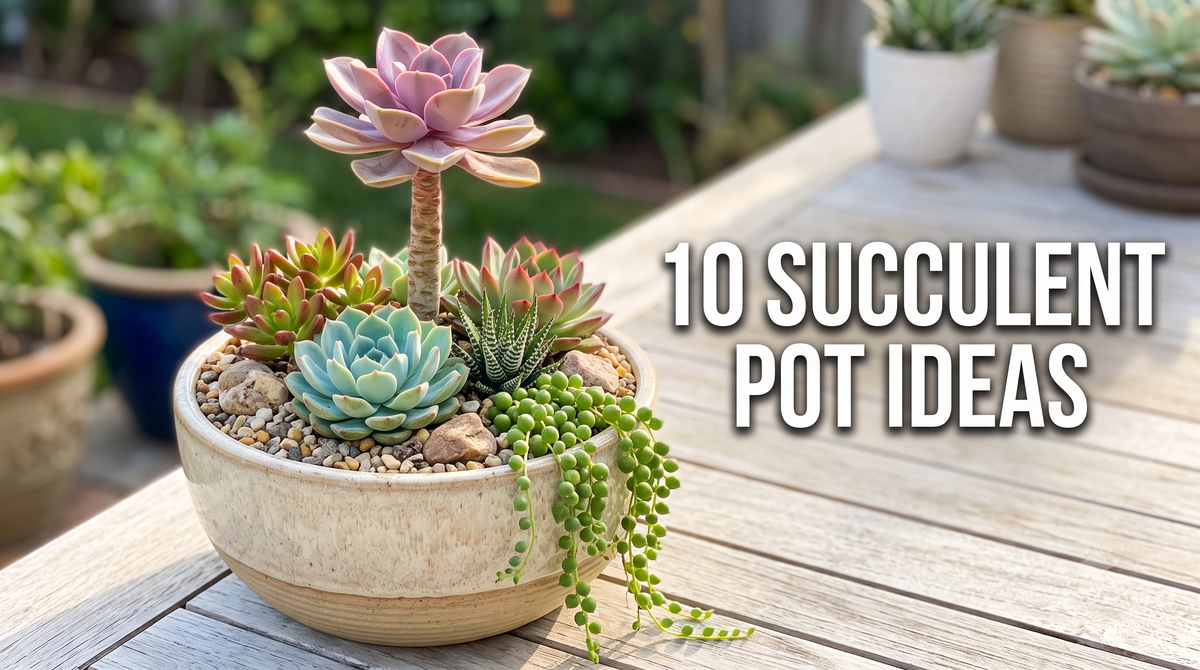
Create a Tall, Medium, and Trailing Arrangement
One of the easiest ways to make a succulent pot look professionally designed is to combine different heights.
Choose one taller or upright succulent as the main focal point.
Then add one or two medium-sized rosette or branching plants around it.
Finally, place a trailing succulent near the edge so its stems can spill over the side of the container.
This creates three visual levels:
Tall
Medium
Trailing
The result is more dynamic than placing plants at exactly the same height.
This type of arrangement works particularly well in a wide bowl or large round planter.
-
Create a Rosette-Focused Arrangement
If you love echeveria-style succulents, you can create an arrangement based almost entirely on rosette shapes.
Choose several rosette succulents with different sizes or colors.
Place the largest rosette slightly off-center rather than directly in the middle. Surround it with smaller rosettes that gradually decrease in size.
Try not to make the arrangement perfectly symmetrical.
A slightly irregular layout can make the container look more natural.
You can also use a small amount of decorative grit around the plants to visually frame the rosettes.
The goal is to make the individual leaf patterns easy to see instead of hiding them beneath neighboring plants.
-
Use Contrasting Leaf Shapes
Color is not the only way to create visual interest.
Leaf shape can be just as important.
Try combining:
Round leaves
Pointed leaves
Long narrow leaves
Fleshy rosettes
Stacked leaves
Trailing stems
For example, a round-leaved succulent can look especially interesting next to a spiky or upright form.
When arranging plants, step back occasionally and look at the container as a whole.
If every plant has the same shape, the arrangement may look flat.
Contrasting forms create more movement and help individual plants stand out.
-
Try a Monochromatic Succulent Pot
Not every arrangement needs lots of different colors.
A monochromatic design can look elegant and modern.
Choose succulents that share a similar color family, such as:
Soft green
Blue-green
Silver
Gray-green
Deep green
Then use different shapes and textures to create contrast.
For example, several blue-green rosettes can be combined with a blue-gray upright succulent and a slightly trailing plant.
The color palette remains simple, while the different shapes keep the arrangement interesting.
This design works particularly well with modern ceramic or concrete planters.
-
Create a Desert-Inspired Bowl
For a more natural landscape look, create a miniature desert-inspired arrangement.
Start with a shallow but appropriately sized container.
Add several compact succulents or small cacti that have compatible growing requirements.
Then finish the surface with decorative gravel, grit, or small stones.
Use rocks as visual features rather than simply covering every part of the soil.
You can create a small dry landscape with:
A focal cactus or upright succulent
One or two rounded plants
A low-growing succulent
A few decorative stones
A layer of suitable grit
The RHS also demonstrates the use of small cacti, rocks, and free-draining compost to create miniature container landscapes.
Remember that decorative gravel does not replace good drainage. The growing medium and container still need to allow excess water to escape.
-
Use the “Thriller, Filler, Spiller” Idea
The classic container-design concept of thriller, filler, and spiller can also inspire succulent arrangements.
The “thriller” is the main focal plant.
It should have an upright, unusual, or visually dominant shape.
The “fillers” are smaller plants that occupy the middle area.
The “spillers” grow toward the edges and eventually trail over the container.
For a succulent arrangement, you might combine:
One upright focal succulent
Two or three compact rosette succulents
One trailing succulent near the edge
This approach makes it easier to plan your arrangement before you begin planting.
It also prevents the common mistake of placing every plant at the same height.
-
Arrange Succulents by Color
If you prefer colorful arrangements, use color deliberately rather than mixing everything randomly.
Start with one dominant color.
Then choose one or two supporting colors.
For example:
Green + pink + cream
Blue-green + purple + silver
Green + red + bronze
Green + yellow-green + burgundy
Place your strongest color where you want the eye to go first.
Use softer colors around it to create balance.
You do not need every plant to be a different color. Repeating the same color in two or three places can actually make the arrangement look more cohesive.
When choosing plants, remember that color can change with growing conditions and seasons. Light exposure, temperature, and plant health can all influence appearance.
-
Build a Texture-Rich Arrangement
Texture is one of the easiest ways to make a succulent container look more sophisticated.
Combine plants with:
Smooth leaves
Bumpy leaves
Hairy surfaces
Powdery or frosted surfaces
Glossy foliage
Spiky forms
Fine, branching stems
A textured arrangement can remain visually interesting even when the colors are very similar.
For example, pair a smooth green rosette with a fuzzy-leaved succulent and a fine trailing plant.
Keep enough space between plants so their individual textures remain visible.
An arrangement does not need to be crowded to look full.
-
Use an Unusual Container
The container itself can become part of the design.
Instead of using a standard round flower pot, consider:
A long rectangular planter
A shallow ceramic bowl
A vintage-style pot
A concrete planter
A stone-look container
A hanging planter
A small trough
A repurposed container designed for planting
Whatever container you choose, make sure it is suitable for planting and provides appropriate drainage.
RHS guidance emphasizes that containers need drainage holes, and unusual containers may need drainage holes added before they are used as planters.
The container should complement the plants rather than compete with them.
A simple pot can make colorful succulents stand out, while a decorative pot may work best with a restrained plant palette.
-
Create a Mini Succulent Landscape
For the most creative option, treat your container like a miniature landscape.
Instead of thinking only about individual plants, imagine creating a tiny scene.
Use:
One taller plant as a focal point
Low-growing succulents as ground cover
Rocks for structure
Decorative grit for pathways or open spaces
A piece of weathered wood for visual interest
Leave some open areas instead of filling every inch with plants.
You can create the impression of a miniature dry garden without making the container feel overcrowded.
This style is especially effective in wider bowls and trough-style planters.
The RHS describes container planting as an opportunity to combine plants, decorative materials, and different heights to create visual interest.

How to Arrange Succulents Before Planting
One of the best beginner tricks is to arrange everything before putting the plants into the soil.
Keep each succulent in its nursery pot.
Place the pots inside the final container.
Start with your focal plant.
Add medium-sized plants around it.
Then place trailing plants near the edges.
Step back and look at the arrangement from different angles.
Move plants around until the composition feels balanced.
Only after you are happy with the layout should you begin planting.
This makes it much easier to experiment without disturbing the roots unnecessarily.

How Much Space Should You Leave Between Succulents?
It can be tempting to pack succulents tightly together because a full container looks attractive immediately.
However, plants continue to grow.
A little breathing room can make the arrangement easier to maintain and gives each plant space to develop.
University of Minnesota Extension specifically recommends considering compatible growth rates when grouping succulents so that one or two plants do not quickly outgrow the others.
When planning your container, think about what the arrangement will look like several months from now, not only on planting day.
Choose plants with similar growth rates when possible, especially in a small shared container.
How to Choose Succulents That Look Good Together
When selecting plants, look for a combination of differences and similarities.
Good combinations often include:
One dominant shape
One contrasting shape
One softer or trailing form
Two or three related colors
Similar light requirements
Similar watering needs
Similar growth rates
This creates visual variety without making the arrangement feel chaotic.
You do not need ten different varieties to make a beautiful succulent pot.
Three to five carefully selected plants can often create a much stronger composition than a crowded collection.
Choosing Healthy Plants Before You Arrange Them
Start with healthy plants.
Look for firm leaves, normal color for the species, and signs of active or stable growth.
Avoid combining plants that are already showing serious signs of stress into a decorative arrangement simply because their colors look good together.
A healthy arrangement begins with healthy individual plants.
Once your container design is complete, proper light, watering, soil, and general care will determine how well it develops.
For more practical advice on encouraging strong succulent growth, see our guide to “How to Make Succulents Grow Faster and Healthier: 10 Simple Tips.”
How to Plant the Arrangement
Once your design is ready, prepare the container with an appropriate succulent growing medium.
Place the plants at suitable depths and avoid burying the stems or rosettes too deeply.
Position the tallest plant first if it is the main focal point.
Then add the remaining plants according to your planned layout.
Fill around the rootballs with growing medium and gently settle the plants into position.
Finish with a thin decorative layer of suitable grit or small stones if desired.
Do not rely on a decorative layer at the bottom of the container as a substitute for drainage. What matters most is having an appropriate container and growing medium that allow excess water to escape.
Give the finished arrangement a little time to settle before moving it to its final location.
Where to Place Your Succulent Arrangement
The best location depends on the specific plants you selected.
Many succulents need plenty of bright light, but not every succulent responds to exactly the same level of direct sunlight.
If the plants were previously grown in lower light, introduce them to stronger sunlight gradually rather than moving them suddenly into intense exposure.
University of Minnesota Extension notes that many succulents benefit from bright light and recommends gradual acclimation when moving plants outdoors.
For indoor arrangements, a bright window can be a good starting point.
For outdoor containers, choose a location that matches the needs of the species in your arrangement.
Remember that the most beautiful container is still a living planting. Its design needs to work with the plants' growing conditions.
Common Succulent Arrangement Mistakes
Even a simple succulent pot can go wrong if the design ignores the plants' needs.
Avoid these common mistakes:
Choosing plants with very different watering requirements.
Using a container without appropriate drainage.
Crowding too many plants into a small pot.
Choosing plants that grow at dramatically different rates.
Putting every plant at exactly the same height.
Using too many unrelated colors.
Hiding the focal plant behind larger plants.
Covering the entire surface with decorative materials.
Moving a low-light plant suddenly into intense sunlight.
Choosing appearance over long-term care requirements.
A beautiful arrangement should be attractive on planting day and practical to maintain afterward.
Final Thoughts
Learning how to arrange succulents in pots is really about combining gardening with simple design principles.
Start with the growing conditions, then think about height, shape, texture, color, and space.
Try a tall-medium-trailing arrangement, a monochromatic bowl, a desert-inspired landscape, or a simple three-plant composition.
Most importantly, choose succulents that can comfortably share the same container conditions. Similar watering needs, compatible growth rates, suitable light requirements, and good drainage will make the arrangement much easier to maintain over time.
You do not need a huge collection of plants or an expensive container to create something beautiful.
With three or four carefully selected succulents, the right pot, and a little attention to composition, you can create a container that looks intentional, balanced, and uniquely your own.