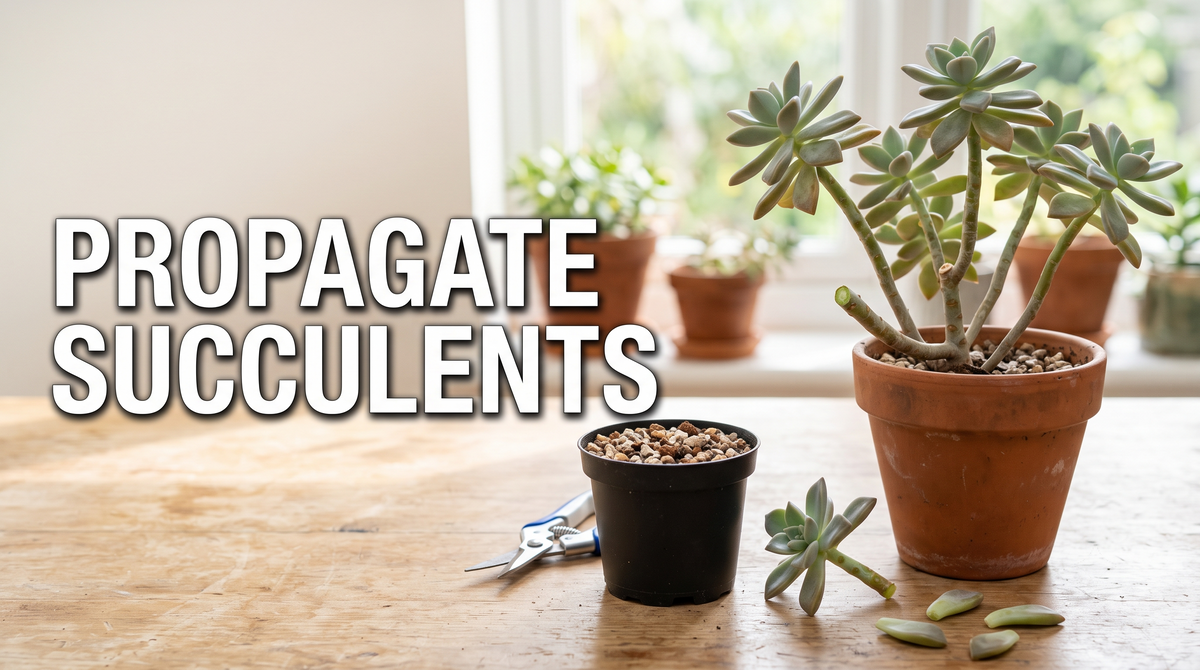
How to Propagate Succulents from Stem Cuttings: A Beginner’s Guide
Succulents are some of the most rewarding plants to propagate at home. Many types can produce new plants from leaves, offsets, or sections of stem, giving you an easy way to expand your collection without buying a new plant every time.
Stem propagation is especially useful for succulents that grow long, branching, or stretched stems. Instead of throwing away healthy stems after pruning, you can often use them to grow new plants.
Learning how to propagate succulents from stem cuttings does not require expensive equipment or complicated techniques. With a healthy parent plant, a clean cutting tool, a suitable growing medium, and a little patience, beginners can get started quite easily.
This guide walks through the entire process, from choosing the right stem to caring for the cutting after it begins to root.
What Is Succulent Stem Propagation?
Stem propagation means growing a new succulent from a section of stem taken from an existing plant.
The cutting is separated from the parent plant and allowed to dry and form a callus over the cut surface. It can then be placed into a suitable growing medium where new roots may develop.
Once the cutting has established a healthy root system, it can continue growing as an independent plant.
Stem cuttings work particularly well for many branching or stem-forming succulents. Iowa State University Extension lists plants such as Aeonium, Crassula, Echeveria, Graptopetalum, Kalanchoe, Sedum, and several others among succulents that can be propagated from stem cuttings.
However, not every succulent should be propagated in exactly the same way. Growth habit, stem structure, season, temperature, and growing conditions can all affect the results.
Why Propagate Succulents from Stem Cuttings?
There are several reasons gardeners choose stem propagation.
First, it can turn pruning material into new plants.
If a succulent has become tall or leggy, you may want to trim the stem to encourage a more compact shape. Rather than discarding the healthy section you remove, you can use it as a cutting.
Stem propagation can also help you create several plants from one mature specimen.
Another advantage is that stem cuttings can be useful when a succulent has a long bare stem with healthy growth at the top. Instead of keeping an unattractive stretched plant, you can take a cutting from the healthy portion and start again.
Propagation is also an enjoyable way to experiment with your plants and learn how they grow.
What You’ll Need
You do not need a large collection of gardening supplies.
For a basic succulent stem-cutting project, prepare:
• A healthy succulent
• Clean, sharp pruning shears or scissors
• A clean surface for preparing cuttings
• A small pot or propagation container
• A well-draining succulent or cactus growing medium
• A label if you are propagating several varieties
• Bright, suitable light
Clean tools are important because dirty cutting equipment can introduce contaminants to fresh plant tissue. Iowa State University Extension also recommends clean, sharp pruners or scissors when taking succulent stem cuttings.
Choose a Healthy Parent Plant
Start with a succulent that is actively growing and generally healthy.
Avoid taking cuttings from a plant that is severely affected by pests, advanced rot, or serious disease.
Look for firm stems and healthy leaves.
If the parent plant has several stems, choose one that is strong enough to recover after the cutting is removed.
It is also useful to inspect the plant carefully before cutting. If you notice mealybugs, scale, mushy tissue, or obvious signs of rot, deal with the underlying problem before using the plant for propagation.
A healthy cutting gives you a much better starting point than trying to propagate damaged or declining tissue.
Step 1: Choose the Right Stem
Look for a healthy section of stem with several leaves or growth points.
For many succulents, a cutting around 3 to 6 inches long can be practical, although the ideal size varies with the plant. Iowa State University Extension gives this range as a general guide for succulent stem cuttings.
The stem should be firm rather than soft or mushy.
If the plant has several branches, you can select one that has healthy growth near the tip.
Avoid stems with extensive damage, discoloration, or obvious rot.
Step 2: Make a Clean Cut
Use clean, sharp pruning shears or scissors.
Make a clean cut rather than crushing or tearing the stem.
Depending on the plant's structure, you may want to make the cut near a node or another appropriate point on the stem.
A node is the point where leaves or new shoots emerge. For many types of stem cuttings, the lower part of the cutting contains tissue from which roots can develop.
RHS guidance for succulent propagation also notes that stems can be cut cleanly and that stems removed during pruning may be used as cuttings.
Do not worry if the parent plant looks slightly bare immediately after pruning. Many branching succulents can produce fresh growth after being trimmed.

Step 3: Remove the Lower Leaves
If your cutting has leaves along the stem, gently remove the leaves from the lower section.
Leave enough healthy foliage near the top to support the cutting as it establishes.
The amount you remove depends on the plant and the size of the cutting.
The important goal is to create a clean lower section that can be inserted into the growing medium without burying unnecessary leaves.
Burying leaves can increase the chance of rot because succulent leaves hold moisture.
Step 4: Let the Cutting Callus
This is one of the most important steps in succulent stem propagation.
Do not immediately plant a freshly cut succulent stem into wet soil.
Instead, place the cutting somewhere clean, dry, and protected from harsh direct sunlight and allow the cut surface to dry.
The cut end gradually forms a callus.
The amount of time required varies by plant, cutting size, temperature, and environmental conditions. RHS notes that succulent cut ends may take anywhere from about a day to a week to callus.
A larger or thicker cutting may require more time than a small one.
Do not rush this stage simply because you are eager to plant the cutting.
The goal is to allow the wound to dry before the cutting is placed into a moist growing environment.
Step 5: Prepare a Well-Draining Growing Medium
Succulent cuttings need a growing medium that does not remain excessively wet.
A cactus or succulent potting mix can be a convenient choice.
You can also use a suitable mineral component such as perlite as part of a propagation mix, depending on the succulent and your growing conditions.
The exact mix is less important than providing good drainage and avoiding a constantly wet environment.
Iowa State University Extension specifically recommends a well-drained growing medium such as cactus potting soil or perlite for succulent stem cuttings.
Use a container with a drainage hole whenever possible.
A decorative container without drainage may look attractive, but it can make moisture management much more difficult.

Step 6: Plant the Callused Cutting
Once the cut end has dried and callused, place the lower portion of the cutting into the growing medium.
Insert it deeply enough to remain stable, but do not bury a large amount of the stem unnecessarily.
Make sure the leaves that remain on the lower portion are not sitting against wet soil.
Gently firm the medium around the stem.
The cutting should stand upright without being packed tightly into the container.
If the stem is unstable, a small support can help keep it upright while roots begin developing.
Step 7: Give It the Right Light
A cutting needs light, but that does not mean placing it immediately in harsh, intense direct sunlight.
A bright location with appropriate indirect or filtered light can be a good starting point.
Very intense sunlight can cause a newly propagated cutting to lose moisture quickly or become damaged before its roots have developed.
RHS propagation guidance generally recommends good light while avoiding scorching direct sunlight during the rooting stage.
As the cutting develops roots and new growth, gradually adjust its light conditions according to the requirements of the particular succulent.
Remember that different succulent species have different light preferences.
Step 8: Water Carefully
One of the most common mistakes beginners make with succulent cuttings is watering too much.
A newly planted cutting does not have a developed root system that can use large amounts of water.
Keeping the growing medium constantly wet can increase the risk of rot.
Instead of following a rigid daily watering schedule, pay attention to the cutting, growing medium, temperature, and environmental conditions.
Once roots begin developing, watering can gradually become more regular according to the needs of the species and the growing medium.
The goal is not to keep the cutting completely dry forever. The goal is to avoid creating a constantly wet environment while the cutting is vulnerable.
Step 9: Wait for Root Development
Succulent propagation requires patience.
Some cuttings may begin producing roots relatively quickly, while others take longer.
Do not pull the cutting out of the soil every few days to check for roots.
Repeatedly disturbing the cutting can interfere with the rooting process.
Instead, look for gradual signs of establishment.
The cutting may become more firmly anchored in the growing medium.
New leaves or shoots may eventually appear.
The plant may also begin showing stronger growth once a functional root system has developed.
RHS notes that propagation methods vary by plant, so there is no single timeline that applies to every succulent.

How Long Do Succulent Stem Cuttings Take to Root?
There is no universal rooting time for every succulent.
Species, cutting size, temperature, light, moisture, growing medium, and the condition of the cutting can all affect how quickly roots form.
Some cuttings may establish relatively quickly, while others require considerably more patience.
Instead of expecting roots on a specific day, focus on providing consistent conditions.
Avoid excessive watering, avoid constant disturbance, and give the cutting suitable light.
With time, a healthy cutting can develop roots and begin producing new growth.
How to Tell If a Cutting Is Rooting
You may not be able to see the roots immediately, especially when the cutting is planted in a solid growing medium.
One of the easiest signs is increased stability.
A cutting that initially moves easily may become more firmly anchored as roots develop.
New leaves or shoots are another encouraging sign.
However, avoid using new growth as the only indicator because different succulents develop at different rates.
If you are curious about root development, resist the temptation to repeatedly pull the cutting from the soil.
Patience is usually more helpful than constant checking.
Common Mistakes When Propagating Succulents from Stem Cuttings
Even easy-to-propagate succulents can fail when the basic conditions are wrong.
One common mistake is planting the cutting immediately after making the cut.
Giving the cut end time to callus is an important part of the process for many succulents.
Another mistake is using soil that stays wet for too long.
Succulent cuttings need a growing medium with good drainage, especially while the cutting is establishing roots.
Overwatering is another frequent problem.
It can be tempting to water frequently because the plant is new, but more water does not automatically mean faster rooting.
Poor lighting can also cause problems.
A cutting needs enough light to support healthy growth, but newly prepared cuttings may need protection from harsh direct sun while they establish.
Finally, avoid propagating from obviously diseased or heavily pest-damaged material.
Start with healthy tissue whenever possible.
Should You Use Rooting Hormone?
Rooting hormone is not always necessary for succulent stem cuttings.
Iowa State University Extension notes that rooting hormone can sometimes help root development, but many succulents root readily without it.
For beginners, it is reasonable to start without rooting hormone and focus on the fundamentals:
A healthy cutting.
A clean cut.
Proper callusing.
A well-draining growing medium.
Appropriate light.
Careful moisture management.
If a particular species is difficult to root, you can research whether rooting hormone is appropriate for that plant.
Can You Propagate Succulents in Water?
Water propagation is popular with many houseplants, but it is not the best general approach for succulent stem cuttings.
Iowa State University Extension specifically notes that most succulents do not root well in a glass of water.
Because succulents store water in their tissues, a well-draining propagation medium is generally a more appropriate starting point for many stem cuttings.
If you are experimenting with a particular species, follow species-specific guidance rather than assuming that a method used for tropical houseplants will work equally well for succulents.
What to Do After Your Cuttings Root
Once a cutting has developed a healthy root system and begins producing new growth, continue caring for it according to the needs of its species.
Avoid moving it into a dramatically larger container too quickly.
Choose a pot with drainage and a suitable succulent growing medium.
As the new plant becomes established, you can gradually transition it into the normal light and watering routine appropriate for that succulent.
Once you have several rooted cuttings, you can also begin creating attractive container combinations.
If you want ideas for combining your new plants, see our guide on how to arrange succulents in pots.
This is a natural next step after propagation: first grow healthy new plants, then use them to create a thoughtful container arrangement.
Stem Cuttings vs. Leaf Cuttings
Stem propagation is not the only way to multiply succulents.
Some succulents, including certain Echeveria and Crassula, can be propagated successfully from leaves. RHS specifically identifies Echeveria and Crassula among succulents that can be propagated by leaf cuttings.
Other plants may produce offsets or pups that can be separated from the parent plant.
The best method depends on the species and its growth habit.
Branching or stem-forming succulents are often good candidates for stem cuttings, while rosette-forming or offset-producing plants may offer other propagation options.
If you are unsure, identify the succulent first and then choose a propagation method suited to that plant.
Final Thoughts
Learning how to propagate succulents from stem cuttings is a simple and rewarding gardening skill.
Start with a healthy plant, choose a firm stem, make a clean cut, remove unnecessary lower leaves, and allow the cut end to callus before planting.
Use a well-draining growing medium, provide appropriate light, and be careful with watering while the cutting develops roots.
Most importantly, give the process time.
Not every cutting will succeed, and different succulent species can behave differently. But with healthy plant material and consistent care, stem propagation can be an enjoyable way to turn one succulent into several new plants.
Once those new plants become established, you can use them to expand your collection, share them with friends, or create beautiful succulent arrangements of your own.