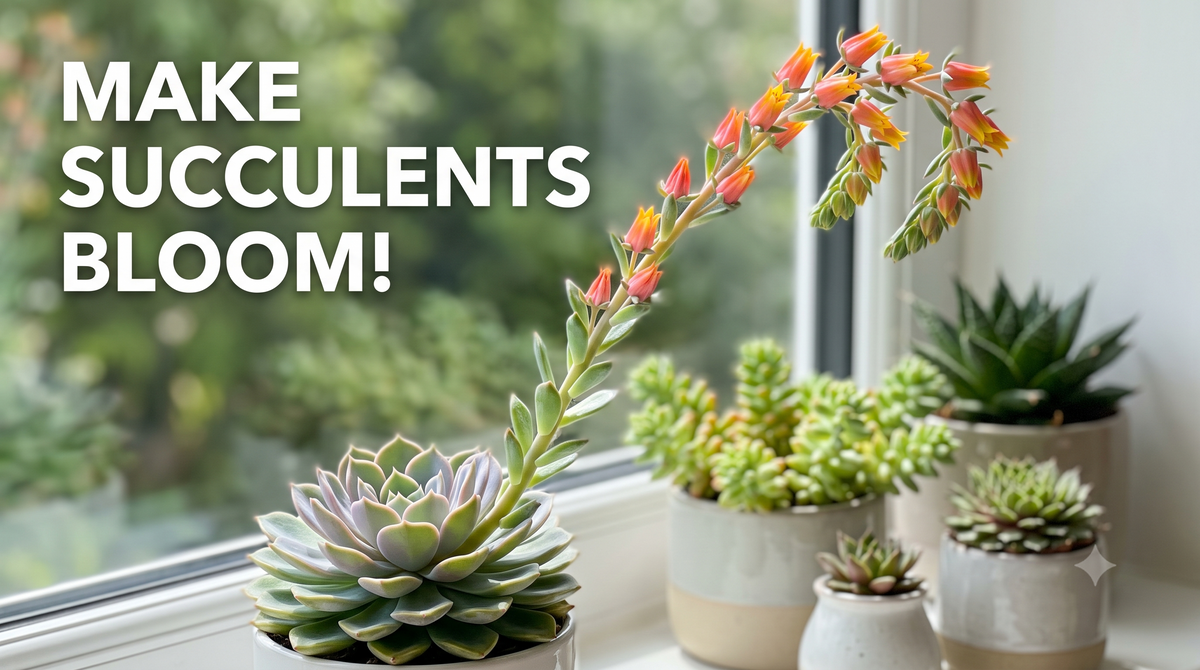
How to Get Succulents to Bloom: A Complete Flowering Guide
Seeing a succulent produce its first flower can be one of the most rewarding moments of growing these plants. A healthy succulent may spend months producing leaves and roots before suddenly sending up a tall flower stalk covered with colorful buds.
If your succulent is growing but never flowering, the problem may not be that you are doing something completely wrong. Flowering depends on the species, maturity, light, temperature, seasonal changes, watering habits, and overall plant health.
The key is to create conditions that support healthy growth while also allowing the plant to experience the seasonal signals it needs to flower.
This guide explains how to get succulents to bloom, why some plants refuse to flower, and how to encourage blooms without overwatering or overfertilizing.
Do All Succulents Bloom?
Yes, many succulents can produce flowers when they reach the appropriate maturity and growing conditions.
However, not every succulent flowers at the same age, frequency, or time of year.
Some mature plants may flower regularly, while others may need several years before they are capable of producing blooms. Some species also flower only under particular seasonal conditions.
Holiday cacti and kalanchoes are good examples of succulents with specific flowering triggers. Holiday cacti respond strongly to shorter days and cooler temperatures, while kalanchoe also requires long nights to initiate flower buds.
So the first step is to identify your succulent and learn what conditions naturally encourage that particular plant to flower.

-
Give Your Succulent Enough Light
Light is one of the most important factors when you want a succulent to bloom.
Many succulents grown indoors need abundant bright light. Low-light conditions can cause pale or stretched growth and may prevent a plant from reaching the healthy growth stage needed for flowering.
A bright window is often a good starting point for indoor succulents.
However, more light does not always mean immediately placing a plant in intense direct sunlight. A succulent that has been growing in lower light can suffer sun damage if it is suddenly moved into strong sunlight.
Instead, increase exposure gradually.
Watch the plant for signs of excessive light, such as bleached areas, brown patches, or scorched tissue.
For indoor plants that do not receive enough natural light, supplemental grow lighting may help. University extension guidance lists succulents among plants that benefit from high-light conditions, while also noting that artificial lighting can supplement insufficient natural light.
The goal is strong, appropriate light—not simply the brightest possible location.
-
Understand Your Succulent's Natural Flowering Season
One of the easiest mistakes is expecting a succulent to flower whenever you want it to.
Plants have natural growth cycles.
Some succulents flower during warmer months, while others flower after experiencing cooler temperatures or shorter days.
Understanding the natural rhythm of your plant can make flowering much easier.
During an active growing period, the plant may focus primarily on producing roots, leaves, stems, and new growth.
Later, seasonal changes in light and temperature can signal the plant to switch toward reproductive growth.
This is particularly important for short-day flowering succulents.
Instead of trying to force flowers throughout the year, learn when your particular succulent normally forms buds.
-
Avoid Keeping the Soil Constantly Wet
Water is necessary for healthy succulent growth, but constantly wet soil can create serious problems.
Succulents generally perform best when their growing medium can dry between waterings. Waterlogged conditions can damage roots and may eventually lead to root rot.
A plant with damaged roots may have difficulty supporting healthy new growth, much less producing flowers.
When your succulent needs water, water thoroughly so the root zone is moistened, then allow excess water to drain away.
Do not leave the pot sitting in water.
The exact watering frequency depends on the species, pot, soil, light, temperature, humidity, and season.
Rather than watering on an unchanging calendar, check the plant and growing medium.
If the soil is still damp, waiting longer may be appropriate.
If the soil has dried and the plant needs water, provide a thorough watering and allow it to drain.
This wet-dry cycle is more useful than simply trying to water a certain number of times each week.
-
Use a Well-Draining Pot and Soil
Good flowering starts with healthy roots.
A succulent growing in dense, water-retentive soil may remain stressed even if the leaves look acceptable for a while.
Choose a pot with drainage holes and use a growing medium that drains efficiently.
A drainage hole is especially important because excess water needs a way to leave the container.
A layer of gravel placed underneath the soil does not replace a drainage hole.
If your succulent has been sitting in wet soil for too long, focus on correcting the root environment before trying to encourage flowering.
A healthy root system gives the plant a much better foundation for new growth and eventual flower production.

-
Give the Plant a Suitable Temperature
Temperature can influence flowering in some succulent species.
Many indoor succulents are comfortable in normal household conditions, but certain flowering succulents respond to cooler nights or seasonal temperature changes.
Holiday cacti provide one of the clearest examples.
These plants form flower buds in response to shorter days and cooler temperatures. University extension guidance recommends cool conditions and long, uninterrupted nights to encourage flowering.
For these plants, keeping them continuously warm under bright indoor lights can interfere with their natural flowering signal.
Other succulents may respond differently.
This is why it is important to identify your plant rather than applying one temperature rule to every succulent.
Avoid sudden temperature extremes, drafts, and placing plants directly next to heaters or air-conditioning vents.
-
Feed During Active Growth, Not All Year
Succulents generally do not need heavy fertilization.
Fertilizer can support healthy growth, but more fertilizer does not automatically mean more flowers.
In fact, excessive fertilization can encourage vigorous leafy growth without producing the flowering response you are hoping for.
For many succulents, fertilizing during active growth in spring and summer is more appropriate than feeding heavily during a low-growth winter period.
Use a fertilizer suitable for succulents or a balanced houseplant fertilizer according to the product label and the needs of your specific plant.
University extension guidance recommends relatively light fertilizer applications for succulents and emphasizes that many require only modest amounts of fertilizer.
Think of fertilizer as supporting an already healthy plant—not as a shortcut to flowers.
-
Let the Plant Mature
Sometimes the reason your succulent is not flowering is simply age.
A small offset, recently propagated cutting, or young plant may need time before it reaches flowering maturity.
This is particularly common when growing succulents from leaves or cuttings.
Propagation is excellent for creating new plants, but a newly rooted cutting may spend a long time building its root system and vegetative growth before it has enough resources to flower.
If the plant looks healthy, produces normal new growth, and has no obvious pest or root problems, patience may be part of the solution.
Do not force a young plant with excessive fertilizer or water.
Instead, focus on strong light, suitable soil, appropriate watering, and healthy growth.
-
Avoid Stressing a Healthy Plant Too Much
There is a difference between giving a plant seasonal conditions and deliberately stressing it.
Some flowering succulents naturally experience dry periods, cooler temperatures, or changes in day length.
That does not mean you should severely dehydrate the plant or expose it to extreme temperatures.
Excessive stress can weaken a succulent instead of encouraging flowers.
If your plant is already showing severe leaf loss, shriveling, soft stems, root problems, or pest damage, solve those issues first.
Healthy flowering is more likely when the plant has sufficient energy and a functioning root system.
-
Remove Spent Flowers When Appropriate
After flowering, old flower stalks can remain attached to the plant.
Once the flowers have completely faded and the stalk begins to dry, you can remove the spent flower structure if appropriate for your species.
Use clean scissors or pruners and avoid cutting healthy leaves or stems unnecessarily.
Removing old flower material can improve the plant's appearance and make it easier to monitor new growth.
However, there is no need to rush.
If a flower stalk is still green and actively producing buds, leave it alone.
-
Give Flowering Succulents Stable Care
Once buds appear, avoid making major changes to the plant's environment.
Sudden changes in temperature, light, watering, or humidity can cause some flowering plants to drop their buds.
Holiday cacti are particularly sensitive during bud development. University of Minnesota Extension notes that drafts and sudden environmental changes can contribute to flower-bud drop.
When you see buds forming, keep the plant in a suitable location and maintain consistent care.
Avoid repeatedly moving it from one room to another simply to find the perfect display location.
How to Encourage a Kalanchoe to Bloom
Kalanchoe is one of the most popular flowering succulents for indoor growing.
If a kalanchoe has healthy leaves but refuses to produce new flower buds, light and day length may be important factors.
Kalanchoe is a short-day plant, meaning flower buds form when the plant experiences long, uninterrupted nights.
Iowa State University Extension recommends bright growing conditions and notes that kalanchoe can be encouraged to rebloom with a period of long nights.
During the flowering induction period, the plant should receive bright daytime light but experience a sufficiently long dark period at night.
Artificial light from lamps or nearby rooms can interfere with this dark period.
The exact timing depends on the desired flowering period and the plant's growing conditions, so follow species-specific guidance when attempting to rebloom a kalanchoe.
How to Get a Holiday Cactus to Bloom
Holiday cacti are slightly different from many desert-style succulents.
Thanksgiving cactus, Christmas cactus, and Easter cactus are associated with cooler, brighter, more seasonal growing conditions and naturally come from forest environments rather than dry deserts.
Holiday cacti form flower buds in response to shorter days and cooler temperatures.
For many holiday cacti, a period of long, uninterrupted darkness combined with cooler nighttime temperatures helps initiate flowering.
University extension sources recommend approximately 12 or more hours of uninterrupted darkness for several weeks, although the exact response varies by plant and conditions.
During this period, keep the plant in bright light during the day and prevent artificial light from interrupting the nighttime darkness.
Once flower buds have formed, avoid moving the plant into a radically different environment.
Sudden temperature changes, drafts, or changes in light can cause flower buds to drop.

Why Is My Succulent Growing but Not Blooming?
A succulent can look healthy and still refuse to flower.
If the plant is producing leaves but no flowers, check these factors:
Is it getting enough appropriate light?
Is it mature enough to flower?
Does the species require a seasonal temperature change?
Does it need shorter days or longer nights?
Are you fertilizing too heavily?
Is the soil staying wet for too long?
Does the container drain properly?
Has the plant recently been repotted or moved?
Is the plant currently in a natural resting period?
Is it actually a species that flowers readily indoors?
These questions are more useful than immediately adding fertilizer or water.
If several environmental conditions are slightly wrong, correcting the overall growing environment may be more effective than changing one factor dramatically.
Common Reasons Succulents Fail to Bloom
Low light is one of the first things to investigate.
A succulent that receives insufficient light may become stretched, pale, or unusually open.
Another common problem is excessive watering. Wet soil can damage roots and create long-term stress.
Overfertilizing is another possibility. More nutrients do not necessarily translate into more flowers.
The plant may also simply be too young.
Finally, the species may require a specific seasonal signal that is missing indoors.
For example, holiday cacti and kalanchoes have specific flowering responses to day length and temperature.
Understanding the plant's natural behavior is often the missing piece.
A Simple Seasonal Flowering Routine
Spring:
Move into stronger appropriate light as needed.
Begin or increase feeding during active growth according to the plant's needs.
Water according to soil dryness and environmental conditions.
Monitor new growth and root health.
Summer:
Maintain strong appropriate light.
Continue active-growth care.
Avoid excessive heat and sudden environmental changes.
Monitor watering more frequently if heat and light increase.
Late summer and fall:
Research whether your species needs shorter days or cooler temperatures to initiate flowering.
For holiday cacti and kalanchoes, begin species-appropriate flowering conditions at the correct seasonal time.
Avoid excessive fertilizer.
Watch for flower buds.
Winter:
Reduce watering if the plant's growth slows and its environmental conditions require less water.
Protect the plant from inappropriate cold.
Maintain adequate light.
Avoid sudden changes once flower buds appear.
This routine is a general framework, not a universal calendar for every succulent.
The exact timing depends on the species and your growing environment.
How Long Does It Take for a Succulent to Bloom?
There is no single timeline for every succulent.
Some plants can flower relatively quickly under good conditions, while others may take years to reach flowering maturity.
Even plants of the same type may bloom at different times depending on age, light, temperature, growing season, and previous care.
If your succulent is healthy but has not flowered yet, avoid assuming that something is wrong simply because it has not produced a bloom.
Look for signs of healthy growth first.
A firm plant with appropriate color, healthy roots, and new growth may simply need more time or the correct seasonal trigger.
What to Do If Your Succulent Starts Producing a Flower Stalk
A flower stalk is exciting, but this is not the time to dramatically change the plant's care.
Continue providing appropriate light.
Water according to the plant's normal needs.
Do not suddenly increase fertilizer.
Keep temperatures reasonably stable.
Avoid moving the plant unnecessarily.
Inspect the plant regularly for pests.
If the flower stalk becomes very tall or heavy, support may sometimes be useful depending on the species.
Once the flowers open, enjoy them and continue normal care.
Can You Make a Succulent Bloom More Often?
You cannot guarantee frequent flowering, because flowering behavior is controlled by the plant's species and growing cycle.
However, you can create conditions that support repeated healthy flowering.
Provide appropriate light.
Keep the roots healthy.
Use well-draining soil.
Water according to plant and environmental conditions.
Feed lightly during active growth when appropriate.
Respect seasonal changes.
Learn the flowering requirements of your particular species.
Most importantly, do not try to force flowers by dramatically changing several care factors at once.
Healthy, consistent care is usually a better long-term strategy.
Final Thoughts
Learning how to get succulents to bloom is less about finding a single secret trick and more about understanding what your particular plant needs.
Start with the basics: bright appropriate light, healthy roots, well-draining soil, suitable watering, and reasonable temperatures.
Then look at the species.
Some succulents simply need time to mature. Others need seasonal changes in temperature or day length before they produce flower buds.
Kalanchoe and holiday cacti are useful examples because their flowering responses can be strongly influenced by long nights and temperature.
If your succulent is not blooming, resist the temptation to add more water or fertilizer immediately. First check its light, roots, soil, age, seasonal conditions, and species-specific requirements.
With the right environment and a little patience, your succulent may eventually reward you with a beautiful display of flowers.
If your succulent is also experiencing leaf loss, take a look at our guide on why your succulent is dropping leaves to help determine whether the problem is normal leaf shedding or a sign of environmental stress.