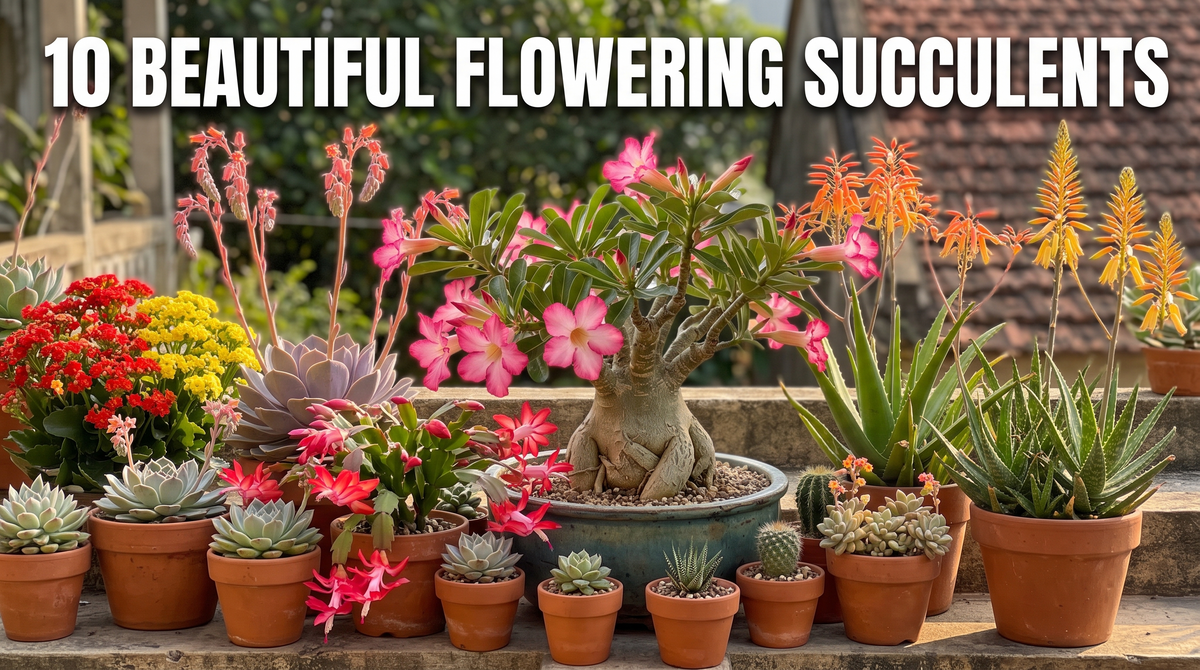
10 Beautiful Flowering Succulents for Your Home and Garden
Succulents are loved for their fascinating shapes, colors, and low-maintenance nature, but many varieties can also produce beautiful flowers.
From colorful Kalanchoe clusters to elegant Echeveria flower stalks and spectacular holiday cactus blooms, flowering succulents can add an extra layer of beauty to a sunny windowsill, patio, container garden, or outdoor landscape.
The important thing to remember is that not every succulent flowers in the same way or at the same time. Light, plant maturity, seasonal changes, temperature, watering, and overall plant health can all influence flowering.
If you want to add more flowers to your succulent collection, here are 10 beautiful choices to consider.
-
Kalanchoe
Kalanchoe is one of the most popular flowering succulents for indoor growing.
Kalanchoe blossfeldiana is grown primarily for its colorful clusters of small flowers. Depending on the variety, blooms can appear in shades of red, pink, orange, yellow, or white.
The flowers stand above the thick, fleshy leaves, creating a strong contrast between the foliage and colorful blooms.
Kalanchoe can work particularly well on a bright windowsill where it receives plenty of light.
One of the reasons it is popular with beginners is its compact growth habit and attractive appearance even when it is not flowering.
For the best results, provide bright light and avoid keeping the soil constantly wet. Good drainage is especially important for succulent plants.
If your Kalanchoe is healthy but refuses to bloom, look at its light and seasonal conditions rather than simply adding more water or fertilizer.
-
Echeveria
Echeveria is famous for its beautiful rosette-shaped foliage, but mature plants can also produce tall flower stalks that rise above the leaves.
The contrast between a compact rosette and a tall flowering stem makes Echeveria particularly attractive in containers and succulent arrangements.
Flowers are usually small and bell-shaped, appearing along the flower stalk.
Echeverias generally prefer bright light and well-draining growing conditions. Indoors, a bright window can help maintain compact growth, although available light varies considerably from one home to another.
If an Echeveria becomes stretched or unusually open, insufficient light may be part of the problem.
Once the plant reaches maturity and receives appropriate growing conditions, flowering may become a beautiful seasonal bonus.
-
Aloe
Aloe is another excellent choice if you want a succulent with both attractive foliage and striking flowers.
Many Aloe species form tall flower stalks that rise well above their fleshy leaves. Depending on the species, flowers may appear in shades of orange, red, yellow, or other warm tones.
The tall flower spikes can create an impressive vertical element in a succulent collection.
Aloe is especially useful in outdoor containers and warm-climate gardens, although some species can also be grown indoors when given sufficient light.
Like many succulents, Aloe generally benefits from a well-draining growing medium and careful watering.
Do not assume that more water will encourage more flowers. Healthy roots and appropriate light are much more important for long-term growth.
-
Jade Plant
Jade plants are usually grown for their thick, glossy leaves and attractive branching structure, but mature plants can also produce clusters of small, star-shaped flowers.
Crassula ovata is commonly known as the jade plant and is one of the familiar succulent houseplants.
Flowering may take patience because younger plants may not bloom readily.
If you have a mature jade plant that has never flowered, focus on providing good growing conditions rather than trying to force it to bloom.
Bright light, appropriate watering, good drainage, and seasonal changes can all contribute to healthy growth.
A mature jade covered with small flowers can be particularly beautiful because the delicate blooms contrast with the thick, sturdy branches and leaves.
-
Crown of Thorns
Crown of thorns is an unusual flowering succulent with a strong personality.
Euphorbia milii can produce colorful structures around its small flowers, with varieties available in several attractive colors.
Its branching growth and thorny stems give it a very different appearance from rosette-forming succulents such as Echeveria.
Crown of thorns can be grown as a container plant and is especially attractive in bright locations.
Because it belongs to the Euphorbia group, handle it carefully. The plant produces a milky sap that can irritate skin and eyes, so gloves and careful handling are a good idea when pruning or repotting.
Give this plant plenty of light and avoid keeping the growing medium excessively wet.
-
Holiday Cactus
Holiday cactus is technically a cactus rather than a typical desert succulent, but it is one of the most spectacular flowering plants commonly included in succulent collections.
Thanksgiving cactus, Christmas cactus, and Easter cactus are closely related flowering plants that produce colorful flowers at the ends of their flattened stem segments.
Unlike many desert succulents, holiday cactus comes from humid forest environments and prefers different growing conditions.
It generally does better with bright, indirect light and well-draining soil rather than harsh, intense sunlight.
Flowering is strongly influenced by seasonal changes in day length and temperature.
As the days become shorter and nights become longer, appropriate conditions can encourage the plant to form flower buds.
Once buds appear, avoid unnecessary changes in temperature, light, or location because sudden environmental changes can contribute to bud drop.
With proper care, a mature holiday cactus can become a spectacular flowering houseplant.

-
Sempervivum
Sempervivum, commonly known as hens and chicks, is best known for its attractive rosettes and ability to produce offsets.
However, mature rosettes can also send up tall flower stalks.
The flowering event is particularly interesting because the flower stalk can rise dramatically above the compact rosette.
Depending on the species and variety, flowers may appear in shades such as pink, red, or other related colors.
Sempervivum is particularly useful for outdoor succulent gardens, rock gardens, and containers in climates where the plants can tolerate local winter conditions.
Because flowering behavior and cold tolerance can vary by species, choose varieties appropriate for your growing environment.
A sunny, well-drained location is generally important for keeping these plants compact and healthy.
-
Fishbone Cactus
Fishbone cactus, also known as ric rac cactus, is an excellent option if you want a flowering succulent with a completely different shape.
Its flattened, zigzag stems create a distinctive appearance even when the plant is not flowering.
The stems can trail or arch, making this plant particularly attractive in hanging containers.
Under suitable conditions, mature plants can produce large, showy flowers.
Fishbone cactus is related to other forest-growing epiphytic cacti, so its care differs from that of many desert succulents.
Bright, filtered light is generally more appropriate than intense direct midday sunlight.
A well-draining growing medium is important, while the plant should not be treated exactly like a drought-adapted desert cactus.
Its unusual foliage combined with large flowers makes it a great choice for gardeners who want something different.
-
Orchid Cactus
Orchid cactus is another flowering cactus with impressive blooms.
Unlike the small flowers of some compact succulents, orchid cactus can produce large and dramatic flowers that become the main attraction of the plant.
Its long, flattened stems can grow in an arching or trailing form, making it suitable for hanging baskets and elevated containers.
Orchid cactus belongs to the group of forest-growing cacti that generally prefer bright but filtered light rather than harsh full sun.
A well-draining growing medium helps prevent problems caused by excess moisture.
Because flowering depends on the plant's overall health and growing conditions, focus first on strong foliage and healthy roots.
Once the plant is mature and conditions are suitable, its flowers can be spectacular.

-
Desert Rose
Desert rose, commonly associated with Adenium, is a striking succulent-like plant grown for its unusual swollen trunk, attractive foliage, and colorful flowers.
Its flowers can create a dramatic display, especially when the plant is mature and growing strongly.
The combination of a sculptural caudex, branches, leaves, and flowers gives desert rose a miniature-tree appearance.
This makes it particularly attractive as a container specimen in warm climates.
Desert rose needs plenty of light and excellent drainage. It is also more sensitive to cold than many hardy outdoor succulents, so growing conditions should be adjusted according to the local climate.
If grown indoors, place it in the brightest suitable location available and pay attention to seasonal changes in growth.
Why Choose Flowering Succulents?
Flowering succulents offer more than just colorful flowers.
Many have attractive foliage even when they are not blooming, which means your plant can remain decorative throughout much of the year.
Their different shapes also make it possible to create interesting combinations.
For example, you could combine:
• Rosette-forming Echeveria
• Compact Kalanchoe
• Tall-flowering Aloe
• Branching jade plants
• Trailing fishbone cactus
• Colorful holiday cactus
• Sculptural desert rose
The result can be much more visually interesting than a collection made from only one plant shape.

How Much Light Do Flowering Succulents Need?
Light is one of the most important factors for healthy succulent growth and flowering.
However, “succulent” is a broad category, and different species have different light preferences.
Many traditional desert succulents appreciate abundant light, while forest-growing cacti such as holiday cactus, fishbone cactus, and orchid cactus generally prefer bright filtered light.
If you move a plant from a relatively dark indoor location into strong direct sunlight, do it gradually.
A sudden change can cause sun damage.
If a succulent consistently receives too little light, it may become stretched, pale, or weakly shaped.
For flowering plants, insufficient light can also make it harder to maintain strong growth and support blooms.
How Often Should You Water Flowering Succulents?
There is no universal watering schedule that works for every flowering succulent.
Instead, consider the plant species, pot size, soil, temperature, light, season, and growing environment.
Most traditional succulents prefer the growing medium to dry between waterings rather than remaining constantly wet.
A pot with drainage holes is essential because excess water needs somewhere to escape.
However, forest-growing flowering cacti are different.
Holiday cactus, for example, generally prefers more consistent moisture during active growth and flowering than many desert succulents.
This is one reason it is important to identify the plant before creating a care routine.
Should You Fertilize Flowering Succulents?
Fertilizer can support healthy growth when used appropriately, but more fertilizer does not automatically mean more flowers.
A healthy plant needs suitable light, water, roots, temperature, and nutrition.
If those basic conditions are not right, fertilizer alone will not solve the problem.
Use a fertilizer appropriate for the plant and follow the product directions rather than applying large amounts.
Different flowering succulents may also have different feeding requirements.
For example, holiday cactus has a different growth pattern from a desert-adapted Echeveria.
The goal should be balanced, healthy growth rather than forcing the plant to flower.
Why Is My Flowering Succulent Not Blooming?
If your succulent grows leaves but never produces flowers, don't assume that something is seriously wrong.
Some plants need to reach a certain level of maturity before flowering.
Other factors may include:
• Insufficient light
• Seasonal conditions that are not suitable for flowering
• Incorrect temperature
• Overwatering
• Poor drainage
• Nutrient problems
• Excessive stress
• A plant that is simply not mature enough
The exact trigger depends on the species.
For example, holiday cactus responds strongly to changes in day length and temperature, while other succulents have different flowering patterns.
This is why identifying your succulent is one of the most useful steps when trying to encourage blooms.
If you want more practical tips for encouraging flowers, read our guide on how to get succulents to bloom.
How to Build a Flowering Succulent Collection
You don't need a large garden to enjoy flowering succulents.
A sunny windowsill can hold a few compact plants.
A patio can accommodate several containers.
A hanging basket can showcase trailing species such as fishbone cactus or orchid cactus.
If you have an outdoor garden, combine different heights and forms.
Place lower rosette-forming plants toward the front, medium-sized plants in the middle, and taller flowering species toward the back.
Just make sure plants grouped together have reasonably compatible light, watering, temperature, and soil requirements.
Avoid combining plants simply because they look good together if their care requirements are completely different.
Final Thoughts
Flowering succulents can bring color and personality to both indoor collections and outdoor gardens.
Kalanchoe, Echeveria, Aloe, jade plants, crown of thorns, holiday cactus, Sempervivum, fishbone cactus, orchid cactus, and desert rose all offer something different.
Some are known for colorful flower clusters, while others produce tall flower stalks or dramatic blooms.
The most important thing is to choose plants that match your growing conditions.
Provide appropriate light, use well-draining soil, water according to the plant's needs, and give mature plants time to develop.
And if your succulent does not bloom immediately, don't give up.
Healthy growth comes first. With the right species and suitable care, the flowers can eventually become one of the most rewarding parts of your succulent collection.
If you are also trying to understand why a healthy-looking succulent suddenly starts losing leaves, take a look at our guide on why your succulent is dropping leaves and what you can do about it.