Why Is My Succulent Dropping Leaves? Causes and Solutions
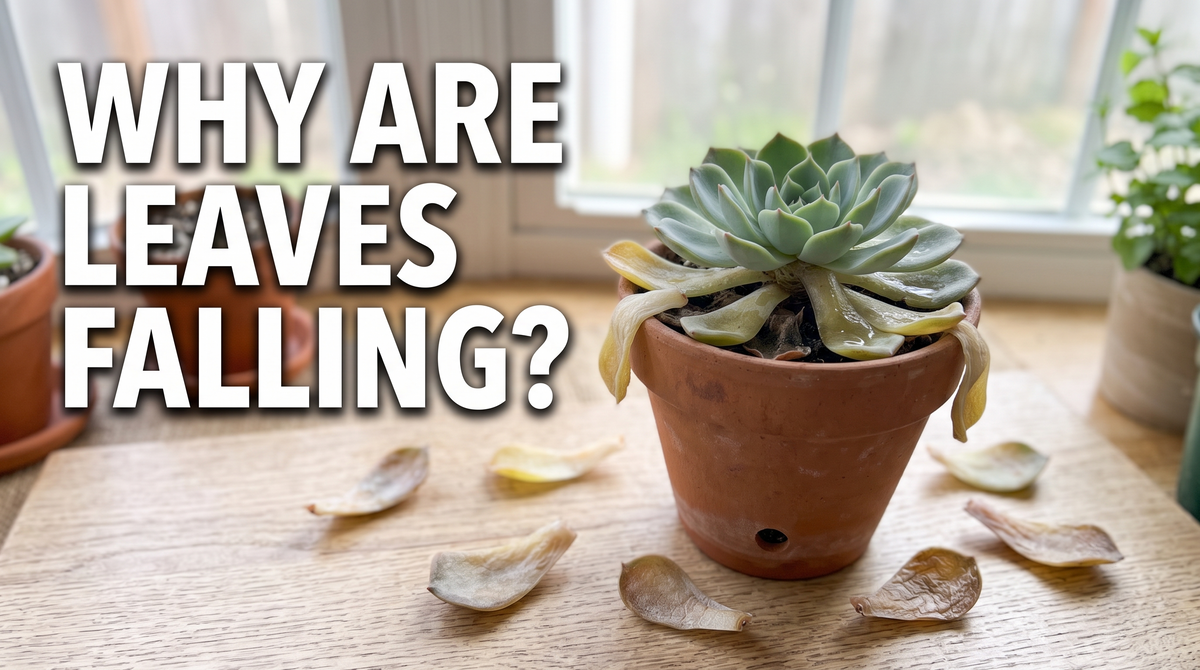
Seeing succulent leaves fall off can be alarming, especially when your plant looked healthy only a few days ago.
But not every fallen leaf means something is seriously wrong.
Succulents naturally shed older leaves as they grow. At the same time, sudden or widespread leaf drop can be a sign of overwatering, underwatering, insufficient light, temperature stress, sun damage, pests, or root problems.
The key is learning how to tell the difference.
If your succulent is dropping one or two old lower leaves while the rest of the plant looks healthy, you may simply be seeing normal growth. If many leaves are falling at once, or the leaves are yellow, brown, soft, mushy, or unusually shriveled, it is worth investigating the growing conditions.
Here are the most common reasons a succulent may be dropping leaves and what you can do about them.
Is It Normal for Succulents to Drop Leaves?
Yes, sometimes.
Many succulents naturally lose older lower leaves as they produce new growth. These leaves may gradually become dry, brown, shriveled, and eventually detach from the plant.
If only one or two of the oldest lower leaves are drying up while the plant remains firm, colorful, and actively growing, there may be no problem at all.
Iowa State University Extension specifically notes that occasional dried lower leaves on otherwise healthy succulents are normal.

The important question is not simply, “Are leaves falling?”
Instead, ask:
Which leaves are falling?
How many are falling?
What do the leaves look like?
Is the stem firm or soft?
Is the soil wet or dry?
Has the plant recently experienced a major change in light or temperature?
These clues can help you identify the real cause.
-
Your Succulent Is Naturally Shedding Older Leaves
The simplest explanation is sometimes the correct one.
As a succulent grows, its oldest lower leaves eventually reach the end of their normal lifespan.
You may notice the lower leaves becoming yellow, brown, dry, or papery before they fall away.
Meanwhile, the newer leaves near the center remain firm and healthy.
This type of leaf drop is usually gradual rather than sudden.
What to do:
You generally do not need to treat normal leaf shedding.
Wait until the leaf is completely dry and easy to remove, then gently pull it away if it does not fall off naturally.
Avoid pulling firmly on a leaf that is still attached.
If the plant continues producing healthy new growth, occasional loss of older lower leaves is usually nothing to worry about.
-
You Are Overwatering Your Succulent
Overwatering is one of the most common causes of succulent problems.
Succulents store water in their leaves and stems, so they generally do not need constantly moist soil.
When the soil stays wet for too long, roots can become damaged. The plant may then begin developing yellow, soft, or mushy leaves that eventually fall off.
In more advanced cases, the stem may become soft and root rot may develop.
Iowa State University Extension identifies yellowing, soft or mushy leaves and stems, and leaf drop as common signs associated with overwatering in succulents.
What to do:
Stop watering while the soil is still wet.
Check whether your pot has an effective drainage hole.
Make sure excess water can drain completely.
Do not leave the pot sitting in water inside a saucer or decorative container.
If the soil is dense, compacted, or stays wet for an unusually long time, consider repotting into a well-draining succulent mix.

-
Your Succulent Is Too Dry
Underwatering can also cause leaves to fall.
Although succulents tolerate dry conditions better than many other houseplants, they still need water to remain healthy and produce new growth.
When a succulent becomes excessively dry, leaves may become wrinkled, shriveled, yellow, or brown before eventually dropping.
The important clue is the condition of the soil.
If the soil is extremely dry and the leaves are thin and wrinkled, underwatering may be contributing to the problem.
What to do:
Check the soil before watering.
When the soil is appropriately dry for your plant and growing conditions, water thoroughly so the entire root ball is moistened and excess water drains away.
Then allow the soil to dry before watering again.
Avoid switching from severe underwatering to constant moisture. Succulents generally do better with a consistent wet-dry watering cycle.
-
Your Succulent Is Not Getting Enough Light
Low light can weaken succulent growth and contribute to leaf problems.
A succulent growing with insufficient light may become pale, stretched, or unusually open. Some rosette-forming succulents flatten their leaves as they try to capture more light.
Insufficient light can also contribute to leaf drop.
University of Minnesota Extension notes that inadequate light can cause plants to become leggy and may cause leaf drop, while Iowa State University specifically describes pale, stretched succulent growth as a symptom of insufficient light.
What to do:
Move the succulent toward a brighter location that suits its species.
If the plant has been growing in low light, increase light gradually rather than suddenly placing it in intense direct sunlight.
A grow light can also be useful when natural indoor light is insufficient.
Give the plant time to adjust. Existing stretched growth will not necessarily return to its previous compact form, but new growth can develop more normally under better light.
-
Your Succulent Was Moved Into Stronger Light Too Quickly
More light is not always better when the change happens suddenly.
A succulent that has been growing indoors or in relatively low light can develop sun damage when it is suddenly moved into strong direct sunlight.
Brown, tan, bleached, or scorched areas may appear on the leaves. Damaged leaves can eventually fall.
Iowa State University Extension recommends gradually transitioning succulents to new light conditions because sudden exposure to strong light can cause sun scald and permanent damage.
What to do:
Move the plant into brighter conditions gradually.
Start with gentler light and increase exposure over time.
Avoid taking a succulent from a dim indoor location and immediately placing it in intense afternoon sun.
Damaged tissue will not return to its original condition, so prevention is more effective than trying to repair burned leaves.
-
The Temperature Changed Suddenly
Succulents can also respond to sudden environmental changes.
Moving a plant from a warm location to a cold draft, placing it next to an air-conditioning vent, or exposing it to major temperature swings can cause stress.
A sudden change in light and temperature can be particularly noticeable when plants are moved between indoor and outdoor environments.
What to do:
Keep your succulent away from strong drafts, heating vents, air-conditioning outlets, and locations with dramatic temperature changes.
If you move a plant outdoors, acclimate it gradually.
Likewise, give an outdoor succulent time to adjust when bringing it indoors.
The goal is not to keep the plant at one exact temperature all the time. Instead, avoid unnecessary extremes and abrupt changes.
-
The Soil Does Not Drain Well
Sometimes the problem is not how often you water but how quickly the soil dries.
A dense or compacted growing medium can retain too much moisture around succulent roots.
Poor drainage creates an environment where roots may remain wet for too long, increasing the risk of root problems and associated leaf drop.
Succulents generally perform best in well-drained growing media and containers with drainage holes.
What to do:
Check how quickly water moves through the pot.
If water remains in the soil for a long time, consider replacing the growing medium with a suitable succulent or cactus mix.
Make sure the container has a drainage hole.
Do not assume that adding a layer of gravel at the bottom of a pot will compensate for a container that lacks proper drainage.
-
The Roots Are Damaged
Root problems can make leaf drop confusing.
A succulent with damaged roots may look dehydrated even when the soil is wet because unhealthy roots cannot take up water normally.
This can lead to shriveling, wilting, and leaf drop.
Root rot commonly develops when roots remain in waterlogged soil. Iowa State University explains that damaged roots can reduce the plant's ability to absorb water, causing symptoms that may be mistaken for underwatering.
What to do:
If leaf drop is widespread and the soil has stayed wet for a long time, inspect the roots.
Remove the plant carefully from its pot and look for signs of severe decay, such as soft or mushy roots.
If root rot is present, remove damaged tissue with a clean tool and repot healthy portions into fresh, well-draining medium when appropriate.
Severely damaged plants may not recover, but healthy sections may sometimes be propagated.
-
Your Succulent Has Pests
Pests can also contribute to unhealthy leaves and leaf drop.
Mealybugs are one example. They can appear as small cottony masses around leaf joints, stems, and leaf veins.
Other pests may cause discoloration, weakening, or visible damage to the plant.
If your succulent is losing leaves unexpectedly, inspect the plant closely rather than assuming the problem is watering.
What to do:
Look closely around the stems, leaf joints, undersides of leaves, and growing points.
If you find pests, isolate the affected plant from nearby succulents.
Treatment depends on the pest and the severity of the infestation. Physical removal and appropriate insect-control products may be useful for some common pests.
Always follow the product label when using any pesticide or insecticidal treatment.
-
Your Succulent Is Stressed by Too Many Changes
Sometimes there is not one obvious problem.
A succulent may experience several environmental changes at the same time.
For example, you might repot the plant, move it to a brighter window, change its watering schedule, and fertilize it within a short period.
Each change can affect the plant.
If the plant is already stressed, several changes at once can make it harder to determine what is actually helping.
What to do:
Think about what changed during the weeks before the leaf drop started.
Did you move the plant?
Did you repot it?
Did you change the watering frequency?
Did the weather suddenly change?
Did you move it from indoors to outdoors?
Did you increase its exposure to direct sunlight?
Once you identify the most likely cause, correct that issue first and give the plant time to respond.
How to Tell the Difference Between Normal and Problematic Leaf Drop
The appearance of the fallen leaves can provide useful clues.
Normal leaf shedding:
Older lower leaves
Gradual loss of one or two leaves
Leaves become dry and papery
The rest of the plant looks healthy
New growth continues normally
Possible overwatering:
Yellow leaves
Soft or mushy leaves
Soft stem
Wet soil
Several leaves dropping
Possible underwatering:
Wrinkled leaves
Shriveled leaves
Very dry soil
Brown or yellow leaves
Plant looks dehydrated
Possible low light:
Pale color
Stretching
Open or flattened rosette
Weak new growth
Possible sun damage:
Brown or tan patches
Bleached areas
Damage after sudden exposure to stronger light
Possible pest problem:
Cottony masses
Visible insects
Sticky residue
Damaged leaves or stems
Keep in mind that these symptoms can overlap. Leaf drop alone cannot always identify the cause.

What Should You Do When Your Succulent Starts Dropping Leaves?
Do not immediately water the plant.
First, inspect it.
Look at the leaves.
Check the soil moisture.
Inspect the stem.
Look at the pot and drainage hole.
Check the roots if root problems are suspected.
Look for pests.
Think about recent changes in light and temperature.
This simple inspection can prevent a common mistake: treating a plant for the wrong problem.
For example, a succulent with root damage may look thirsty even though its soil is already wet. Adding more water can make the underlying problem worse.
How to Prevent Succulent Leaf Drop
You cannot prevent every fallen leaf. Normal aging is part of a succulent's life cycle.
However, you can reduce avoidable leaf drop by giving your plant stable growing conditions.
Provide the appropriate amount of light for the species.
Use well-draining soil.
Choose a container with drainage holes.
Allow the soil to dry appropriately between waterings.
Avoid leaving water in saucers or decorative outer pots.
Protect the plant from sudden temperature extremes.
Acclimate it gradually when changing light conditions.
Check regularly for pests.
Avoid making multiple major care changes at once.
Observe the plant instead of following a rigid watering calendar.
A consistent routine is usually more useful than trying to correct problems with frequent changes.
Can a Succulent Grow New Leaves After Dropping Them?
Often, yes, if the plant remains healthy and has a functioning growing point.
Once the underlying problem is corrected, the succulent may gradually produce new leaves.
However, recovery takes time.
If leaves were lost because of low light, overwatering, root damage, or another environmental problem, the plant first needs suitable conditions before it can return to healthy growth.
Do not judge recovery after only a few days.
Look for gradual improvement in firmness, color, new growth, and overall plant structure.
When Should You Be Concerned?
A few dry lower leaves are usually not a reason to panic.
Pay more attention when leaf drop is sudden, widespread, or accompanied by other symptoms.
Be especially cautious if you see:
Soft or mushy stems
Rapid yellowing
Black or severely damaged roots
Persistent wet soil
Severe shriveling
Visible pests
Large areas of sun damage
A plant that is collapsing or losing leaves rapidly needs closer inspection.
The sooner you identify the underlying environmental problem, the better your chance of preventing additional damage.
Final Thoughts
So, why is your succulent dropping leaves?
Sometimes the answer is completely normal: older lower leaves are simply reaching the end of their life.
Other times, leaf drop is a signal that something needs attention.
Overwatering, underwatering, poor drainage, insufficient light, sudden light changes, temperature stress, root damage, and pests can all contribute to leaf loss.
The most useful approach is to look at the entire plant rather than focusing on the fallen leaves alone.
Check the soil, roots, light, temperature, pot, and recent changes in care.
And remember that healthy succulent care is not about preventing every leaf from falling. It is about creating conditions where the plant can naturally replace old growth with healthy new growth.
If your succulent is also growing very slowly, our guide on why your succulent is not growing can help you troubleshoot light, watering, soil, roots, temperature, and other common growth problems.