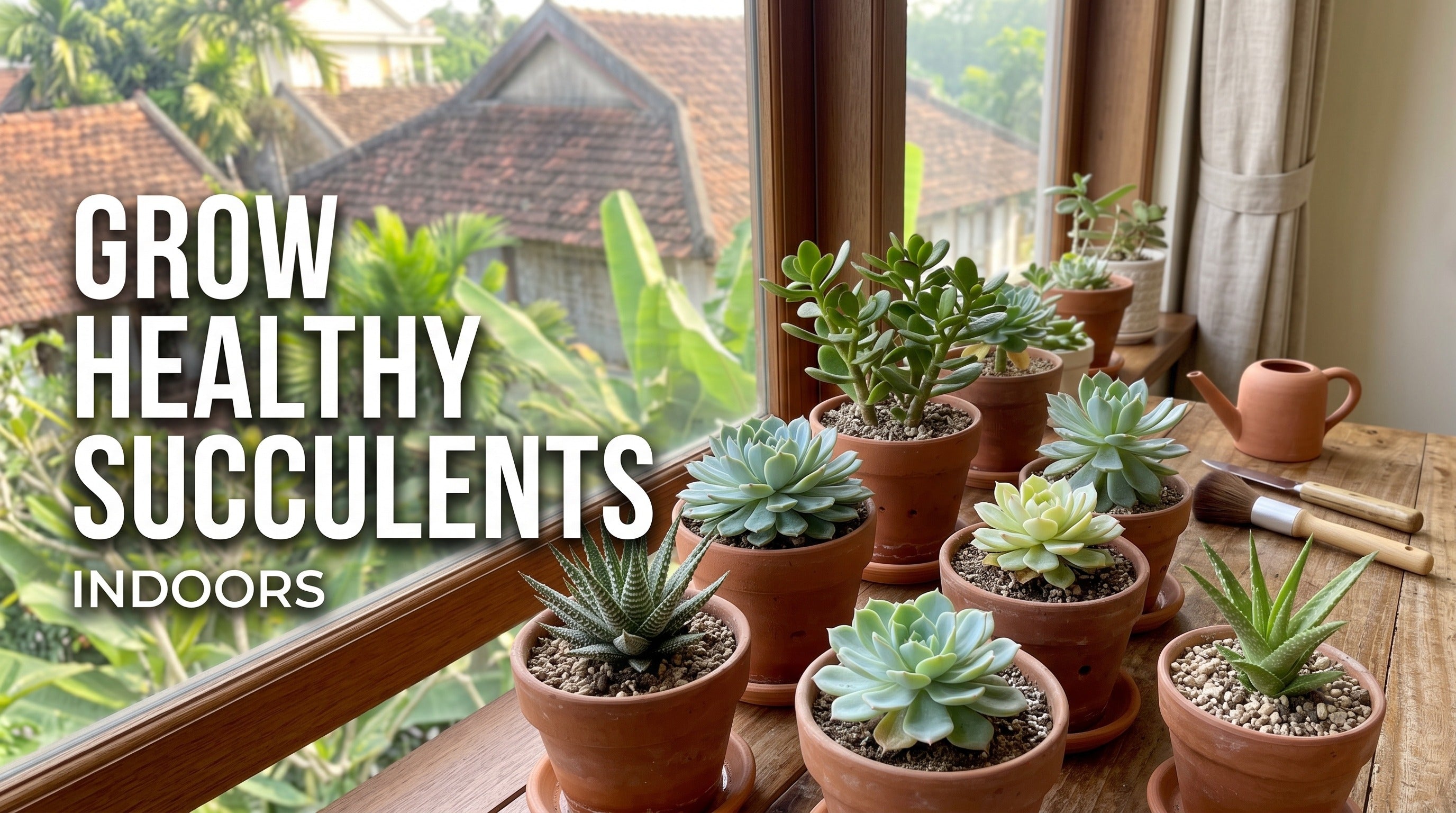
How to Grow Healthy Succulents Indoors: A Complete Guide
Succulents are some of the easiest plants to grow indoors, but they still need the right conditions to stay healthy.
Their thick leaves and stems allow many succulents to store water, which means they generally need less frequent watering than many traditional houseplants.
However, growing succulents indoors is not simply a matter of placing a plant on a shelf and occasionally giving it water.
Indoor environments can have lower light levels, limited air circulation, and different temperature and humidity conditions than outdoor spaces.
The good news is that you can create a healthy indoor environment for succulents with a few simple adjustments.
In this complete guide, you will learn how to grow succulents indoors, including how to choose the right plants, provide enough light, water correctly, select soil and pots, and avoid the most common indoor care problems.
Why Are Succulents Good Indoor Plants?
Succulents are popular indoor plants because many varieties are compact, attractive, and relatively low-maintenance.
Their ability to store water allows them to tolerate periods of dry soil better than many plants that require consistently moist conditions.
Succulents also come in a wide range of shapes, colors, textures, and growth habits.
Some stay small enough for a windowsill, while others can become impressive statement plants.
For beginners, this variety makes it easy to find a succulent that fits your home and growing conditions.
Choose the Right Succulent for Indoor Growing
Not every succulent will perform equally well in every indoor environment.
Before buying a plant, think about how much natural light your home receives.
A bright south- or west-facing window can provide very different conditions from a darker room with only indirect light.
Popular succulents for indoor growing include:
- Haworthia
- Gasteria
- Aloe
- Jade plants
- Echeveria
- Sedum
- Sempervivum
- Crassula
Some varieties tolerate indoor conditions better than others.
If your home does not receive much natural light, choose plants known for tolerating lower-light conditions rather than buying a sun-loving succulent and hoping it will adapt.

The Right Amount of Light for Indoor Succulents
Light is one of the most important factors in successful indoor succulent care.
Most succulents prefer bright light.
A location near a sunny window can often provide the conditions they need.
However, placing a succulent directly against very hot glass can sometimes cause excessive heat or leaf damage.
Watch how your plant responds.
Signs that a succulent may not be receiving enough light include:
- Stretched or elongated growth
- Large spaces between leaves
- Leaning toward the window
- Loss of compact shape
- Reduced coloration
This stretched growth is commonly called etiolation.
Once a succulent has stretched due to insufficient light, moving it to a brighter location can help future growth become more compact, although existing stretched growth will not automatically return to its original shape.
If natural light is insufficient, a suitable grow light can supplement available sunlight.
When using artificial lighting, follow the manufacturer's recommendations for distance and duration.
Rotate Your Succulents
If your succulent sits near a window, rotate the pot occasionally.
Plants naturally grow toward their strongest light source.
Rotating the container can help the plant receive light more evenly and may reduce one-sided growth.
You do not need to rotate the plant constantly.
A simple occasional adjustment is usually enough.
How to Water Succulents Indoors
Watering is one of the biggest challenges for indoor succulent growers.
The most common problem is watering too frequently.
Succulents generally prefer a cycle of thorough watering followed by a period when the soil dries out.
Instead of watering according to a fixed calendar, check the soil and the condition of the plant.
When the soil has dried significantly, water thoroughly until excess water drains from the bottom of the pot.
Then allow the soil to dry again before watering.
Avoid giving tiny amounts of water every few days.
Frequent shallow watering can keep the upper portion of the soil repeatedly damp without properly soaking the root zone.
How Often Should Indoor Succulents Be Watered?
There is no universal schedule.
Indoor watering frequency depends on:
- Light level
- Temperature
- Humidity
- Pot size
- Soil composition
- Plant variety
- Season
- Root development
A succulent receiving strong light in a warm room may dry much faster than one sitting in a cooler, darker location.
The best approach is to learn how quickly your specific plant and potting mix dry.
Always check the soil before watering.
Why Drainage Matters So Much
Good drainage is essential for indoor succulents.
Succulent roots need access to air as well as water.
If water remains trapped around the roots for long periods, the growing environment can become unhealthy.
Choose containers with drainage holes whenever possible.
After watering, allow excess water to escape completely.
Do not allow the pot to sit in a tray filled with standing water.
Decorative pots without drainage holes can look attractive, but they require much more careful watering.
For beginners, a container with a drainage hole is generally the safer option.
The Best Soil for Indoor Succulents
Regular houseplant potting soil can hold more moisture than many succulents prefer.
A well-draining succulent or cactus mix is often a better starting point.
A good succulent growing medium should allow excess water to move through the pot while still providing enough support for the roots.
Depending on the plant and growing conditions, growers may use a combination of organic potting material and mineral components such as:
- Perlite
- Pumice
- Coarse sand
- Grit
- Other appropriate drainage materials
The exact recipe does not need to be complicated.
The most important goal is creating a growing medium that does not remain wet for an extended period.

Choosing the Right Pot
The container can have a major effect on indoor succulent health.
Terracotta pots are popular because the porous material can allow some moisture to evaporate through the sides.
However, terracotta is not required.
Ceramic, plastic, and other containers can work as long as watering is adjusted to the pot and growing conditions.
Choose a pot that is appropriate for the size of the root system.
An excessively large pot can hold more soil than necessary, which may make it harder for the growing medium to dry between waterings.
Always prioritize drainage over appearance.
Temperature and Air Circulation
Most common indoor succulents are comfortable with typical household temperatures.
Avoid placing them directly next to heating vents, air conditioners, or other sources of strong temperature fluctuations.
Good air circulation is also helpful.
You do not need a powerful fan blowing directly at the plant.
Simply avoiding stagnant, constantly damp conditions can help create a healthier growing environment.
Do not place succulents in areas where condensation regularly collects.
How to Fertilize Indoor Succulents
Succulents generally do not require heavy feeding.
During active growth, you can use a balanced fertilizer or a fertilizer formulated for succulents, following the product's dilution and application instructions.
Avoid applying more fertilizer than recommended.
Excess nutrients can create unnecessary stress for plants and may contribute to weak or abnormal growth.
If your succulent is newly planted, severely stressed, or not actively growing, it may be better to focus on proper light, watering, and soil conditions before adding fertilizer.
How to Repot Indoor Succulents
Succulents do not necessarily need to be repotted every year.
Consider repotting when:
- Roots are filling the container
- The plant has become unstable
- The soil has broken down
- Drainage has become poor
- The container is clearly too small
- The plant needs fresh growing medium
Choose a new pot only slightly larger than the current container unless there is a specific reason to use a larger one.
When repotting, handle the roots carefully and allow any damaged areas to settle before returning to a normal watering routine.
After repotting, follow the care recommendations appropriate for the plant and its condition.
How to Keep Indoor Succulents Compact and Healthy
A healthy indoor succulent should generally produce growth that matches its available light.
If your plant becomes tall, thin, or stretched, light is often the first factor to investigate.
Move the plant gradually toward a brighter location rather than suddenly exposing a low-light plant to intense direct sunlight.
This gradual adjustment can help reduce the risk of light stress.
Pruning can also be useful for certain branching succulents.
Remove damaged or unhealthy growth with clean tools and avoid unnecessary cutting.
Keep Leaves and Plants Clean
Dust can accumulate on indoor succulent leaves over time.
A layer of dust may reduce the amount of light reaching the leaf surface.
You can gently remove dust with a soft brush or another suitable method.
Avoid excessive handling of plants with delicate powdery coatings because touching them can remove their natural surface bloom.
Keeping the growing area clean can also make it easier to spot pests and other problems early.
Common Indoor Succulent Problems
Even low-maintenance plants can develop problems.
The good news is that many issues provide visible clues.
Yellow Leaves
Yellowing leaves can have several causes.
Overwatering is one common possibility, especially when yellow leaves are accompanied by soft or swollen tissue.
However, natural aging can also cause older lower leaves to yellow and fall.
Look at the entire plant and consider recent watering, light, soil, and temperature conditions before changing your care routine.
Brown Leaves
Brown or dry areas can result from several environmental factors.
Too much intense sunlight, physical damage, underwatering, or other stress can contribute to browning.
The location and appearance of the brown tissue can provide useful clues.
Soft or Mushy Leaves
Soft, translucent, or mushy leaves are often a warning sign that the plant is receiving too much moisture or that roots are struggling.
Check the soil immediately.
If the soil remains wet for an extended period, inspect the drainage and watering routine.
If you want a more detailed guide to diagnosing these symptoms, read our article on Why Are My Succulent Leaves Turning Yellow, Brown, or Soft?
Pests
Indoor succulents can occasionally attract pests such as mealybugs, scale, or other common houseplant pests.
Inspect leaves, stems, and areas where leaves meet the stem.
Early detection generally makes pest management easier.
Isolate an affected plant from other plants when appropriate and use a treatment suitable for the specific pest.
How to Arrange Succulents Indoors
Succulents can work well on:
- Sunny windowsills
- Shelves near bright windows
- Desks with strong natural light
- Plant stands
- Indoor greenhouse cabinets
- Bright kitchen areas
Avoid choosing a location based only on appearance.
A beautiful shelf in a dark corner may not provide enough light for a sun-loving succulent.
Instead, match the plant to the available conditions.
If you have a low-light room, consider choosing a more shade-tolerant succulent or adding supplemental lighting.
Seasonal Indoor Succulent Care
Succulent care may need to change throughout the year.
During periods of strong growth, plants may use water more quickly.
During cooler or darker periods, growth can slow and the soil may remain wet for longer.
This means you should not automatically keep the same watering schedule throughout the year.
Check the soil and observe the plant regularly.
Adjust watering and lighting based on actual conditions rather than following a rigid calendar.

A Simple Indoor Succulent Care Routine
A simple routine can help keep indoor succulents healthy.
Once a week, inspect your plants.
Look for:
- Changes in leaf color
- Soft or damaged leaves
- Signs of pests
- Stretching
- Dry or compacted soil
- Problems around the pot or drainage tray
Check the soil before watering.
Rotate plants near windows occasionally.
Remove dead leaves from the soil surface.
Clean away visible dust when necessary.
These small habits can help you notice problems before they become serious.
Beginner Mistakes to Avoid
Overwatering is one of the most common mistakes.
Another is placing a succulent in a dark room simply because the plant is labeled "low maintenance."
Other mistakes include:
- Using a container without drainage
- Keeping the soil constantly damp
- Choosing a pot that is much too large
- Ignoring signs of insufficient light
- Fertilizing too frequently
- Moving plants abruptly from low light to intense sunlight
- Ignoring pests
- Watering according to a fixed calendar instead of checking conditions
Avoiding these mistakes can make indoor succulent care much easier.
Final Thoughts
Growing healthy succulents indoors is easier when you focus on a few fundamentals.
Provide enough light.
Use well-draining soil.
Choose containers with drainage holes.
Water thoroughly but allow the soil to dry appropriately between waterings.
Avoid excessive fertilizer.
Watch your plants for changes in color, shape, texture, and growth.
The most important thing is to observe your plants rather than relying on a rigid care schedule.
Every home has different light, temperature, and humidity conditions.
Once you understand how your indoor environment affects your succulents, it becomes much easier to adjust their care.
With the right combination of light, drainage, watering, and regular observation, succulents can remain attractive and healthy additions to your indoor garden for years.