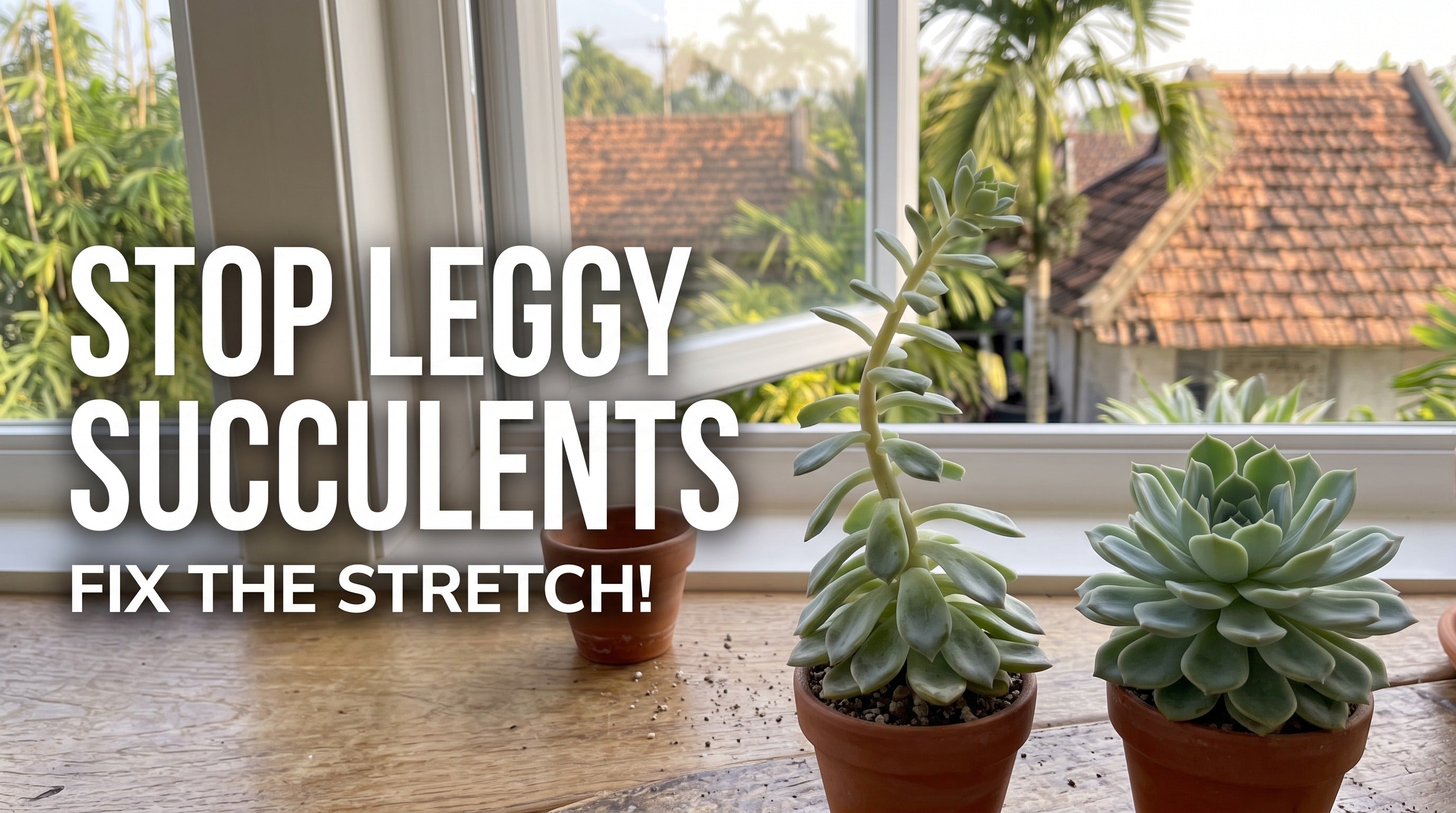
How to Prevent Succulents from Getting Leggy and Stretched
Have you ever noticed your succulent growing taller, thinner, or strangely stretched instead of staying compact and full?
You are not alone.
One of the most common problems with indoor succulents is leggy growth. A plant that once looked short and beautifully compact can slowly develop a long stem with leaves spaced farther apart.
This stretched appearance is usually a sign that the plant is trying to reach more light.
The good news is that leggy growth can often be prevented by making a few changes to the plant's growing conditions.
In this guide, you'll learn why succulents become leggy, how to prevent succulent stretching, what to do when your plant is already stretched, and how to encourage healthier, more compact growth.
What Does “Leggy” Mean in Succulents?
A leggy succulent has unusually long, stretched growth with larger gaps between its leaves.
Instead of producing compact growth close to the center of the plant, the stem extends outward or upward.
You may notice:
- Long, thin stems
- Large spaces between leaves
- Leaves growing toward a window
- Pale or less colorful new growth
- A plant leaning strongly toward one direction
- A top-heavy appearance
- A succulent that looks much taller than it did originally
This type of growth is commonly associated with insufficient light.
Plants naturally respond to limited light by extending their growth toward a brighter source.
For succulents, this can quickly change their compact shape.

Why Do Succulents Get Leggy?
The most common reason succulents become stretched is inadequate light.
Succulents generally need bright light to maintain strong, compact growth.
When a plant is kept too far from a window, placed in a dark corner, or receives weaker seasonal light, it may begin stretching toward the available light.
This is sometimes called etiolation.
A succulent does not necessarily stretch because you are doing something completely wrong.
It may simply be trying to find more light.
However, once stretched growth has developed, moving the plant into better light will not make the existing elongated stem automatically become short again.
The goal is to improve future growth and, when necessary, prune and restart the plant.
Signs Your Succulent Needs More Light
Your plant may be asking for more light if you notice several of these changes.
The Stem Is Getting Longer
If new growth appears farther apart than older growth, insufficient light may be involved.
The Plant Is Leaning
A succulent that consistently bends toward a nearby window may be reaching for a stronger light source.
Leaves Are Spaced Far Apart
Healthy compact growth usually has relatively close leaf spacing.
Long gaps between leaves can indicate stretching.
New Growth Looks Pale
Some succulents naturally change color throughout the year, but unusually pale or weak new growth can be another sign that the plant is not receiving enough light.
The Plant Has Changed Shape
If your once-compact succulent suddenly becomes tall and open, compare its current location with the amount of light it receives.
How Much Light Do Succulents Need?
There is no single light requirement for every succulent species.
However, many commonly grown succulents prefer bright conditions.
A sunny windowsill can work well for many varieties, although intense direct sunlight through glass can also cause problems for plants that are not acclimated.
The important thing is to avoid thinking of light as simply “sun” or “shade.”
Light intensity changes depending on:
- Window direction
- Distance from the window
- Season
- Glass
- Curtains
- Nearby buildings
- Trees
- Weather
- Indoor lighting
A plant sitting several feet away from a bright window may receive dramatically less usable light than a plant positioned much closer.
This is why simply placing a succulent in a bright room does not always provide enough light.
Choose a Better Location
One of the easiest ways to prevent succulent stretching is to evaluate where the plant is sitting.
Look at the plant's current location during different times of the day.
Does sunlight reach the plant?
Does the plant receive bright light for several hours?
Is it sitting behind a thick curtain?
Is it several feet away from the nearest window?
Is another plant, wall, or building blocking the light?
Move the succulent closer to an appropriate bright window when necessary.
However, do not suddenly place a plant that has been growing in low light into intense direct sunlight for hours.
A sudden change can stress or scorch foliage.
Instead, increase exposure gradually.
Rotate Your Succulent Regularly
If your succulent grows toward one side of the window, rotating the pot can help the plant receive light more evenly.
Turn the container slightly every few days or once a week.
This will not fix insufficient light, but it can help prevent the plant from developing an extreme lean toward one direction.
Think of rotation as a supporting habit rather than a replacement for adequate light.
Use a Grow Light When Natural Light Is Limited
Some homes simply do not have enough bright natural light for healthy succulent growth.
This can happen in apartments, north-facing rooms, shaded rooms, or during darker seasons.
In these situations, a suitable grow light can provide supplemental lighting.
The exact setup depends on the type of succulent, the light's intensity, and the distance between the plant and the light.
Avoid assuming that any ordinary household lamp will provide the same results as a plant grow light.
If you use artificial lighting, follow the manufacturer's recommended distance and schedule.
The goal is consistent supplemental light rather than leaving a plant under a light continuously.
Keep Watering Consistent
Light is the biggest factor to address when preventing stretched succulent growth, but watering still matters.
Succulents store water in their leaves and stems, so they generally do not need constantly wet soil.
Overwatering can create other problems, including root damage and poor growth.
At the same time, watering should not be used as a way to compensate for poor lighting.
For example, moving a succulent into a dark corner and simply watering it less does not solve the underlying light problem.
Instead, evaluate the growing environment as a whole.
Provide suitable light, use a well-draining growing medium, and water according to the plant's needs and the condition of the soil.

Avoid Excessive Fertilizer
Fertilizer is not a solution for leggy growth.
If your succulent is stretching because it lacks light, adding extra fertilizer may encourage growth without correcting the underlying problem.
This can result in weak or unattractive growth.
Focus first on light and overall growing conditions.
If your succulent needs fertilizer, use an appropriate product according to its label and the plant's growing season.
Choose a Well-Draining Soil
Good soil does not directly prevent etiolation, but it supports healthy root conditions.
Succulents generally benefit from a growing medium that drains efficiently rather than remaining wet for long periods.
If the roots are healthy, the plant has a better foundation for producing new growth once its light conditions improve.
Avoid heavy, poorly draining soil that stays wet for extended periods.
A pot with drainage holes is also important.
Do Not Expect Stretched Growth to Shrink
This is one of the most important things to understand.
Once a succulent has developed a long, stretched section of stem, improving the lighting will not usually cause that existing section to become compact again.
The new growth may become more compact.
The old stretched section will remain stretched.
This means that pruning is often the best way to restore the plant's appearance.
How to Fix a Leggy Succulent
If your succulent is already stretched, do not panic.
In many cases, you can improve its appearance by combining better lighting with careful pruning.
First, move the plant into a more suitable light environment.
Then allow it to adjust gradually if the new location is significantly brighter.
Once the plant is growing under appropriate conditions, you can decide whether pruning is necessary.
How to Prune a Stretched Succulent
Use a clean, sharp pair of scissors or pruning shears.
Identify the section of healthy growth you want to keep.
Make a clean cut through the stem.
For many branching succulents, cutting just above a leaf node can encourage new growth from that area.
Do not repeatedly make random cuts simply to shorten the plant.
Instead, think about the final shape you want.
After pruning, allow the cut section to dry and callus as appropriate for the type of succulent before attempting propagation.
The exact approach can vary between succulent species.
Can You Propagate the Cuttings?
Yes, many succulent stem cuttings can be propagated.
This is one reason leggy growth does not necessarily mean the plant is a lost cause.
A stretched plant can sometimes become the source of several new plants.
After taking a suitable cutting, allow the cut end to dry and callus according to the needs of the species.
Then place the cutting in an appropriate well-draining growing medium.
Avoid treating a fresh cutting like a fully rooted plant.
It has different moisture needs while it is developing roots.
If your succulent has become severely stretched, pruning and propagation can give you an opportunity to create a new, compact plant while preserving healthy sections of the original.
What About the Remaining Stem?
Do not automatically throw away the remaining stem after pruning.
Depending on the species and condition of the plant, the remaining stem may produce new growth.
Place the plant in suitable light and continue normal care.
Over time, new shoots may develop from nodes below the cut.
This can create a fuller-looking plant.
However, not every succulent responds in exactly the same way, so patience is important.
How to Prevent Succulents from Stretching Indoors
Indoor succulents are especially vulnerable to stretching because household light can be much weaker than outdoor light.
Use these habits to reduce the risk.
Place the plant near a suitable bright window.
Rotate the container regularly.
Watch new growth rather than only the older leaves.
Move plants seasonally when necessary.
Use supplemental grow lighting when natural light is inadequate.
Avoid placing light-loving succulents in dark corners.
Do not assume a room is bright enough simply because it feels bright to you.
Pay attention to how the plant responds.
If new growth becomes increasingly elongated, reassess the light.
If you're growing succulents indoors and want a complete overview of lighting, watering, soil, and placement, see our guide on How to Grow Healthy Succulents Indoors.

Watch the New Growth
One of the easiest ways to evaluate your care routine is to look at what happens after you make a change.
Older stretched growth will not suddenly become compact.
Instead, examine the new leaves and stem growth.
Are the leaves closer together?
Is the plant growing more upright?
Is it still leaning strongly toward the window?
Does the new growth look stronger?
These observations can tell you whether your lighting adjustment is helping.
Common Mistakes That Cause Succulent Stretching
Keeping Succulents Too Far From a Window
A bright room is not necessarily a bright growing location.
The farther a plant is from the window, the less useful light it may receive.
Choosing a Dark Decorative Corner
Succulents can look beautiful on shelves, desks, and decorative tables.
But if the location is too dark, the plant may sacrifice its compact shape to reach available light.
Increasing Water Instead of Light
When a plant looks unhealthy, some people respond by watering more.
If the real problem is insufficient light, more water will not solve it.
Ignoring Seasonal Changes
A location that works well during summer may provide much less light during winter.
Pay attention to changes in daylight throughout the year.
Moving Directly From Low Light to Harsh Sun
A succulent that has adapted to lower light can be sensitive to a sudden increase in intense sunlight.
Increase light exposure gradually.
Expecting Pruning to Solve Everything
Pruning can improve the shape of an already stretched succulent, but it does not fix the reason the plant stretched in the first place.
If the lighting problem remains, new growth may stretch again.
A Simple Routine for Compact Succulents
You do not need a complicated routine.
Once a week, take a quick look at your plants.
Check:
- New growth
- Leaf spacing
- Plant direction
- Light exposure
- Soil condition
- Signs of stress
- Overall shape
If the plant is consistently leaning or producing increasingly long gaps between leaves, investigate the lighting before changing everything else.
If the plant is healthy and growing compactly, avoid making unnecessary changes.
When Should You Move a Succulent?
Consider moving your succulent when:
- New growth is clearly stretching
- The plant is leaning strongly toward a window
- Leaves are becoming unusually spaced apart
- The current location receives very little direct or bright light
- Seasonal changes have reduced available daylight
Make changes gradually, especially when moving a plant from low light into much stronger sunlight.
Healthy adjustment is usually better than sudden environmental shock.
Final Thoughts
Leggy succulents are usually a sign that something about the growing environment needs attention, and light is often the first factor to investigate.
The best way to prevent succulent stretching is to provide appropriate bright light, monitor new growth, rotate plants when useful, and adjust their location as seasonal conditions change.
If a succulent is already stretched, don't assume it is ruined.
Improving the light can help future growth become more compact, while careful pruning can restore a more attractive shape.
Many cuttings can also be propagated, giving you another opportunity to grow healthy new plants.
Remember that the goal is not simply to make a succulent look perfect overnight.
Focus on creating the right conditions for strong, compact growth over time.
With the right light and consistent care, you can greatly reduce the chances of your succulents becoming leggy and stretched.